February 09, 2014


To listen to program CLICK HERE

In 1951, Mr. Ahmad Jamal first recorded 'Ahmad's Blues' on Okeh Records. His arrangement of the folk tune 'Billy Boy', and 'Poinciana' (not his original composition), also stem from this period. In 1955, he recorded his first Argo (Chess) Records album that included 'New Rhumba', 'Excerpts From The Blues', 'Medley' (actually 'I Don't Want To Be Kissed'), and 'It Ain't Necessarily So' --all later utilized by Miles Davis and Gil Evans on the albums “Miles Ahead” and “Porgy and Bess.” In his autobiography, Mr. Davis praises Mr. Jamal's special artistic qualities and cites his
influence. In fact, the mid-to-late 1950's Miles Davis Quintet recordings notably feature material previously recorded by Mr. Jamal: 'Squeeze Me', 'It Could Happen To You', 'But Not For Me', 'Surrey With The Fringe On Top', 'Ahmad's Blues', 'On Green Dolphin Street' and 'Billy Boy'.


In 1956, Mr. Jamal, who had already been joined by bassist Israel Crosby in 1955, replaced guitarist Ray Crawford with a drummer. Working as the “house trio” at Chicago's Pershing Hotel drummer Vernell Fournier joined this trio in 1958 and Mr. Jamal made a live album for Argo Records entitled “But Not For Me”. The resulting hit single and album, that also included 'Poinciana' -- his rendition could be considered his “signature”. This album remained on the Ten Best-selling charts for 108 weeks -- unprecedented then for a jazz album. This financial success enabled Mr. Jamal to realize a dream, and he opened a restaurant/club, The Alhambra, in Chicago. Here the Trio was able to perform while limiting their touring schedule and Mr. Jamal was able to do record production and community work.
Mr. Jamal was born on July 2, 1930, in Pittsburgh, Pennsylvania. A child prodigy who began to play the piano at the age of 3, he began formal studies at age 7. While in high school, he completed the equivalent of college master classes under the noted African-American concert singer and teacher Mary Caldwell Dawson and pianist James Miller. He joined the musicians union at the age of 14, and he began touring upon graduation from Westinghouse High School at the age of 17, drawing critical acclaim for his solos. In 1950, he formed his first trio, The Three Strings. Performing at New York's The Embers club, Record Producer John Hammond “discovered” The Three Strings and signed them to Okeh Records (a division of Columbia, now Sony Records).
Mr. Jamal has continued to record his outstanding original arrangements of such standards as 'I Love You', 'A Time For Love', 'On Green Dolphin Street' (well before Miles Davis!), 'End of a Love Affair', to cite a few. Mr. Jamal's own classic compositions begin with 'Ahmad's Blues' (first recorded on October 25, 1951!), 'New Rhumba', 'Manhattan Reflections', 'Tranquility', 'Extensions', 'The Awakening', 'Night Mist Blues' and most recently 'If I Find You Again', among many others..
In 1994, Mr. Jamal received the American Jazz Masters award from the National Endowment for the Arts. The same year he was named a Duke Ellington Fellow at Yale University, where he performed commissioned works with the Assai String Quartet. A CD is available of these works.
In 1970, Mr. Jamal performed the title tune by Johnny Mandel for the soundtrack of the film “Mash!”; and in 1995, two tracks from his hit album “But Not For Me” -- 'Music, Music, Music', and 'Poinciana' -- were featured in the Clint Eastwood film “The Bridges of Madison County”.

Mr. Jamal's CD entitled “The Essence” features tenor saxophonist George Coleman -- Mr. Jamal's first recording made with a horn! Critical acclaim and outstanding sales resulted in two prestigious awards: D'jango D'or (critics) and Cloch (for sales) in France. Its success generated a concert at Salle Pleyel, and a CD has been released “Ahmad Jamal a Paris” (1992) and a second “live” concert by Mr. Jamal in l996 under the same title, unissued except in France and available on the Dreyfus Records on the Internet, Mr. Jamal rightly considers one of his best recordings. Ahmad Jamal's 70th Birthday “live” concert recording Olympia 2000, is known as “The Essence Part III”. “The Essence, Part II”, featured Donald Byrd on the title track, and on his CD entitled “Nature”, Stanley Turrentine is featured on 'The Devil's In My Den', and steel drummer Othello Molineaux augments the trio format. Continuing his recording career, Mr. Jamal released “In Search of” on CD, and his first DVD “Live In Baalbeck”.
For students of the piano, Hal Leonard Publications has published “The Ahmad Jamal Collection”, a collection of piano transcriptions. Mr. Jamal continues to record exclusively for the French Birdology label, and his albums are released on Verve and Atlantic in the United States.
Mr. Jamal is an exclusive Steinway piano artist.

Mr. Jamal's 'About My Life' story in his own words:
At three years of age, my wonderful Uncle Lawrence stopped me while I was walking past the piano in my parents' living room. He was playing the piano and challenged me to duplicate what he was doing. Although I had never touched this or any piano, I sat down and played note for note what I had heard. “The rest is history.”
What a thrilling ride it has been and continues to be. I was born in one of the most remarkable places in the world for musicians and people in the arts - Pittsburgh, PA. At seven years, I was selling newspapers to Billy Strayhorn's family. Billy had already left home; I didn't get to meet him until years later. Following is a partial listing of “Pittsburghers:”
George Benson
Roy Eldridge
Art Blakey
Errol Garner
Kenny Clarke
Earl “Fatha” Hines
Billy Eckstein
Phyllis Hyman
Maxine Sullivan
Gene Kelly
Stanley Turrentine
Joe Kennedy, Jr.
Earl Wild
Oscar Levant
Mary Loe Williams
Lorin Maazel
George Hudson (his orchestra was my first job away from home, I was 17 and just out of high school.) - Dodo Marmarosa
Dakota Staton
Billy Strayhorn
At seven years of age I began my studies with a wonderful woman, Mary Cardwell Dawson. In addition to her great influence on me, she was very influential in the careers of many musical personalities on a local, as well as worldwide basis. One of her students is my life long friend, violinist, Joe Kennedy, Jr. Later, while still in my teens, I began studying with James Miller, as a result of Mrs. Dawson's relocation to Washington, D.C.
After touring with George Hudson's Orchestra, I traveled to Chicago with The Four Strings, a group headed by violinist, Joe Kennedy, Jr. Unfortunately, the group disbanded because of a lack of employment and in 1951, I formed The Three Strings.
The year 1951 was the beginning of my recording career. “Ahmad's Blues,” which I wrote in 1948 during my stint with a song and dance team out of East St. Louis, was one of my first recordings; “Ahmad's Blues” has been heard in the stage play, “Who's Afraid of Virginia Woolf?,” and recorded by Marlena Shaw, Natalie Cole, Red Garland and others. The first session also included my arrangement of the folk tune, “Billy Boy,” which arrangement was copied by many of my peers. I wrote “New Rhumba” around 1951 and it has also been recorded and performed by many others, most notably Miles Davis. My most famous recording was done in Chicago in 1958 at the Pershing Hotel with two of the most talented musicians of the century, Israel Crosby and Vernell Fournier.
Five decades covering my career are most interesting to me and contain some of the historical data that you can find by clicking the indicated categories of my web page menu. What you can't find won't be available until my proposed autobiography goes to print.

To Visit Ahmad Jamal's website CLICK HERE

January 25, 2014

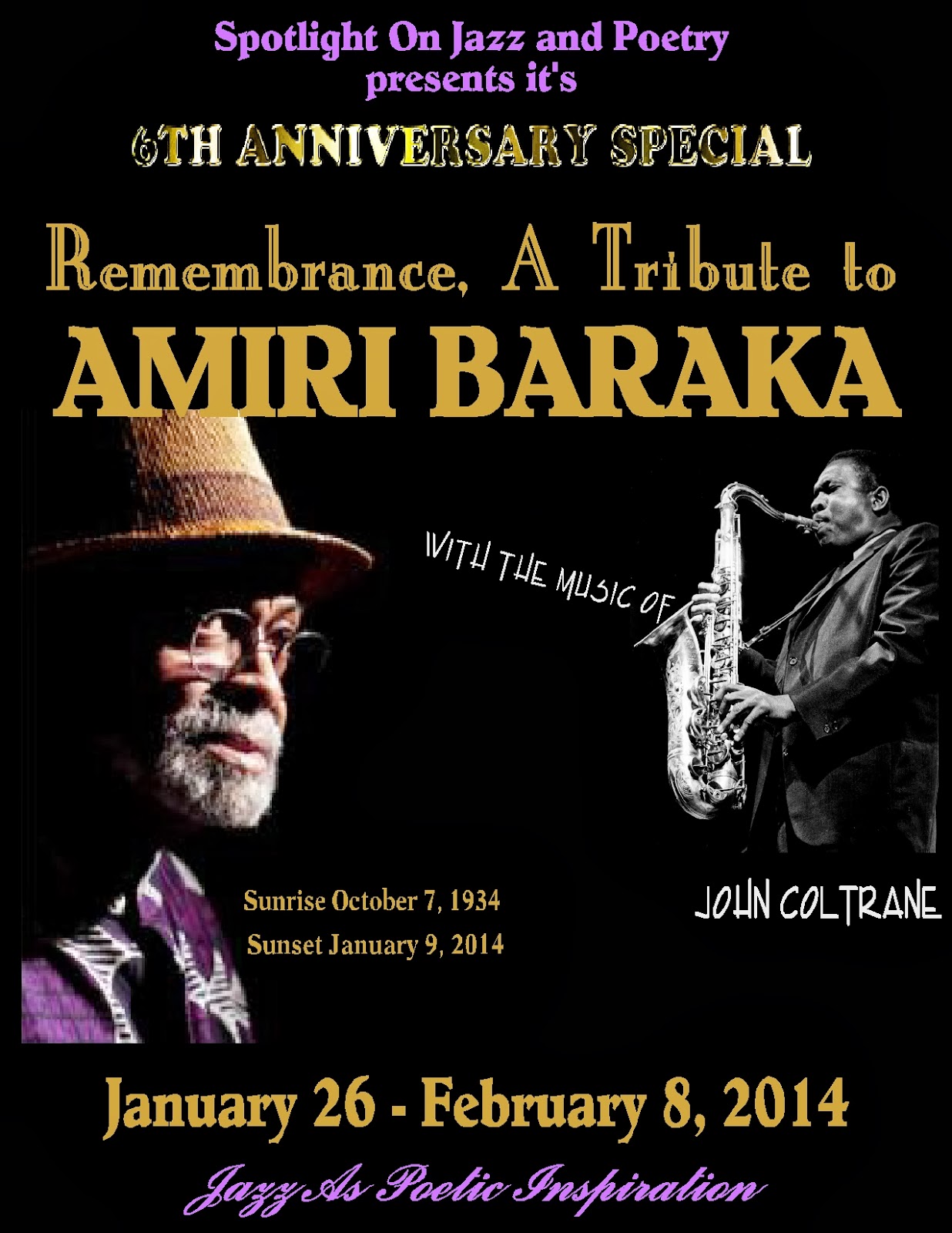
Remembrance; A Tribute to Amiri Baraka


Poet, writer, teacher, and political activist Amiri Baraka was born Everett LeRoi Jones in 1934 in Newark, New Jersey. He attended Rutgers University and Howard University, spent three years in the U.S. Air Force, and returned to New York City to attend Columbia University and the New School for Social Research. Baraka was well known for his strident social criticism, often writing in an incendiary style that made it difficult for some audiences and critics to respond with objectivity to his works. Throughout most of his career his method in poetry, drama, fiction, and essays was confrontational, calculated to shock and awaken audiences to the political concerns of black Americans. For decades, Baraka was one of the most prominent voices in the world of American literature.
Baraka’s own political stance changed several times, thus dividing his oeuvre into periods: as a member of the avant-garde during the 1950s, Baraka—writing as Leroi Jones—was associated with Beat poets like Allen Ginsberg and Jack Kerouac; in the ‘60s, he moved to Harlem and became a Black Nationalist; in the ‘70s, he was involved in third-world liberation movements and identified as a Marxist. More recently, Baraka was accused of anti-Semitism for his poem “Somebody Blew up America,” written in response to the September 11 attacks.

Baraka incited controversy throughout his career. He was praised for speaking out against oppression as well as accused of fostering hate. Critical opinion has been sharply divided between those who agree, with Dissent contributor Stanley Kaufman, that Baraka’s race and political moment have created his celebrity, and those who feel that Baraka stands among the most important writers of the twentieth century. In the American Book Review, Arnold Rampersad counted Baraka with Phyllis Wheatley, Frederick Douglass, Paul Laurence Dunbar, Langston Hughes, Zora Neale Hurston, Richard Wright, and Ralph Ellison “as one of the eight figures . . . who have significantly affected the course of African-American literary culture.”

Baraka did not always identify with radical politics, nor did his writing always court controversy. During the 1950s Baraka lived in Greenwich Village, befriending Beat poets Allen Ginsberg, Frank O’Hara, and Gilbert Sorrentino. The white avant-garde—primarily Ginsberg, O’Hara, and leader of the Black Mountain poets Charles Olson—and Baraka believed in poetry as a process of discovery rather than an exercise in fulfilling traditional expectations. Baraka, like the projectivist poets, believed that a poem’s form should follow the shape determined by the poet’s own breath and intensity of feeling. In 1958 Baraka founded Yugen magazine and Totem Press, important forums for new verse. He was married to his co-editor, Hettie Cohen, from 1960 to 1965. His first play, A Good Girl Is Hard to Find, was produced at Sterington House in Montclair, New Jersey, that same year. Preface to a Twenty Volume Suicide Note, Baraka’s first published collection of poems appeared in 1961. M.L. Rosenthal wrote in The New Poets: American and British Poetry since World War II that these poems show Baraka’s “natural gift for quick, vivid imagery and spontaneous humor.” Rosenthal also praised the “sardonic or sensuous or slangily knowledgeable passages” that fill the early poems. While the cadence of blues and many allusions to black culture are found in the poems, the subject of blackness does not predominate. Throughout, rather, the poet shows his integrated, Bohemian social roots. The book’s last line is “You are / as any other sad man here / american.”

With the rise of the civil rights movement Baraka’s works took on a more militant tone. His trip to Cuba in 1959 marked an important turning point in his life. His view of his role as a writer, the purpose of art, and the degree to which ethnic awareness deserved to be his subject changed dramatically. In Cuba he met writers and artists from third world countries whose political concerns included the fight against poverty, famine, and oppressive governments. In Home: Social Essays (1966), Baraka explains how he tried to defend himself against their accusations of self-indulgence, and was further challenged by Jaime Shelley, a Mexican poet, who said, “‘In that ugliness you live in, you want to cultivate your soul? Well, we’ve got millions of starving people to feed, and that moves me enough to make poems out of.’” Soon Baraka began to identify with third world writers and to write poems and plays with strong political messages.


Dutchman, a play of entrapment in which a white woman and a middle-class black man both express their murderous hatred on a subway, was first performed Off-Broadway in 1964. While other dramatists of the time were wedded to naturalism, Baraka used symbolism and other experimental techniques to enhance the play’s emotional impact. The play established Baraka’s reputation as a playwright and has been often anthologized and performed. It won the Village Voice Obie Award in 1964 and was later made into a film. The plays and poems following Dutchman expressed Baraka’s increasing disappointment with white America and his growing need to separate from it. Critics observed that as Baraka’s poems became more politically intense, they left behind some of the flawless technique of the earlier poems. Richard Howard wrote of The Dead Lecturer (1964) in the Nation: “These are the agonized poems of a man writing to save his skin, or at least to settle in it, and so urgent is their purpose that not one of them can trouble to be perfect.”
To make a clean break with the Beat influence, Baraka turned to writing fiction in the mid-1960s, penning The System of Dante’s Hell (1965), a novel, and Tales (1967), a collection of short stories. The stories are “‘fugitive narratives’ that describe the harried flight of an intensely self-conscious Afro-American artist/intellectual from neo-slavery of blinding, neutralizing whiteness, where the area of struggle is basically within the mind,” Robert Elliot Fox wrote in Conscientious Sorcerers: The Black Postmodernist Fiction of LeRoi Jones/Baraka, Ishmael Reed, and Samuel R. Delany.The role of violent action in achieving political change is more prominent in these stories, as is the role of music in black life.

In addition to his poems, novels and politically-charged essays, Baraka is a noted writer of music criticism. His classic history Blues People: Negro Music in White America (1963) traces black music from slavery to contemporary jazz. Finding indigenous black art forms was important to Baraka in the ‘60s, as he was searching for a more authentic voice for his own poetry. Baraka became known as an articulate jazz critic and a perceptive observer of social change. As Clyde Taylor stated in Amiri Baraka: The Kaleidoscopic Torch, “The connection he nailed down between the many faces of black music, the sociological sets that nurtured them, and their symbolic evolutions through socio-economic changes, in Blues People, is his most durable conception, as well as probably the one most indispensable thing said about black music.” Baraka also published the important studies Black Music (1968) and The Music: Reflections on Jazz and Blues (1987). Lloyd W. Brown commented in Amiri Baraka that Baraka’s essays on music are flawless: “As historian, musicological analyst, or as a journalist covering a particular performance Baraka always commands attention because of his obvious knowledge of the subject and because of a style that is engaging and persuasive even when the sentiments are questionable and controversial.”


After Black Muslim leader Malcolm X was killed in 1965, Baraka moved to Harlem and founded the Black Arts Repertory Theatre/School. The Black Arts Movement helped develop a new aesthetic for black art and Baraka was its primary theorist. Black American artists should follow “black,” not “white” standards of beauty and value, he maintained, and should stop looking to white culture for validation. The black artist’s role, he wrote in Home: Social Essays (1966), is to “aid in the destruction of America as he knows it.” Foremost in this endeavor was the imperative to portray society and its ills faithfully so that the portrayal would move people to take necessary corrective action. He married his second wife, Amina, in 1967. In that same year, Baraka published the poetry collection Black Magic,which chronicles his separation from white culture and values while displaying his mastery of poetic technique. There was no doubt that Baraka’s political concerns superseded his just claims to literary excellence, and critics struggled to respond to the political content of the works. Some felt the best art must be apolitical and dismissed Baraka’s newer work as “a loss to literature.” Kenneth Rexroth wrote inWith Eye and Ear that Baraka “has succumbed to the temptation to become a professional Race Man of the most irresponsible sort. . . . His loss to literature is more serious than any literary casualty of the Second War.” In 1966 Bakara moved back to Newark, New Jersey, and a year later changed his name to the Bantuized Muslim appellation Imamu (“spiritual leader,” later dropped) Ameer (later Amiri, “prince”) Baraka (“blessing”).


By the early 1970s Baraka was recognized as an influential African-American writer. Randall noted in Black World that younger black poets Nikki Giovanni and Don L. Lee (later Haki R. Madhubuti) were “learning from LeRoi Jones, a man versed in German philosophy, conscious of literary tradition . . . who uses the structure of Dante’s Divine Comedy in his System of Dante’s Hell and the punctuation, spelling and line divisions of sophisticated contemporary poets.” More importantly, Arnold Rampersad wrote in the American Book Review, “More than any other black poet . . . he taught younger black poets of the generation past how to respond poetically to their lived experience, rather than to depend as artists on embalmed reputations and outmoded rhetorical strategies derived from a culture often substantially different from their own.”

After coming to see Black Nationalism as a destructive form of racism, Baraka denounced it in 1974 and became a third world socialist. He produced a number of Marxist poetry collections and plays in the 1970s that reflected his newly adopted political goals. Critics contended that works like the essays collected in Daggers and Javelins (1984) lack the emotional power of the works from his Black Nationalist period. However, Joe Weixlmann, in Amiri Baraka: The Kaleidoscopic Torch, argued against the tendency to categorize the radical Baraka instead of analyze him: “At the very least, dismissing someone with a label does not make for very satisfactory scholarship. Initially, Baraka’s reputation as a writer and thinker derived from a recognition of the talents with which he is so obviously endowed. The subsequent assaults on that reputation have, too frequently, derived from concerns which should be extrinsic to informed criticism.”


In more recent years, recognition of Baraka’s impact on late 20th century American culture has resulted in the publication of several anthologies of his literary oeuvre.The LeRoi Jones/Amiri Baraka Reader (1999) presents a thorough overview of the writer’s development, covering the period from 1957 to 1983. The volume presents Baraka’s work from four different periods and emphasizes lesser-known works rather than the author’s most famous writings. Transbluency: The Selected Poems of Amiri Baraka/LeRoi Jones (1961-1995), published in 1995, was hailed by Daniel L. Guillory in Library Journal as “critically important.” And Donna Seaman, writing inBooklist, commended the “lyric boldness of this passionate collection.” Kamau Brathwaite described Baraka’s 2004 collection, Somebody Blew up America & Other Poems, as “one more mark in modern Black radical and revolutionary cultural reconstruction.” The book contains Baraka’s controversial poem of the same name, which he wrote as New Jersey’s poet laureate. After the poem’s publication, public outcry became so great that the governor of New Jersey took action to abolish the position. Baraka sued, though the United States Court of Appeals eventually ruled that state officials were immune from such charges.
Baraka’s legacy as a major poet of the second half of the 20th century remains matched by his importance as a cultural and political leader. His influence on younger writers has been significant and widespread, and as a leader of the Black Arts movement of the 1960s Baraka did much to define and support black literature’s mission into the next century. His experimental fiction of the 1960s is considered some of the most significant African-American fiction since that of Jean Toomer. Writers from other ethnic groups have credited Baraka with opening “tightly guarded doors” in the white publishing establishment, noted Maurice Kenney in Amiri Baraka: The Kaleidoscopic Torch, who added: “We’d all still be waiting the invitation from the New Yorker without him. He taught us how to claim it and take it.”

Baraka was recognized for his work through a PEN/Faulkner Award, a Rockefeller Foundation Award for Drama, and the Langston Hughes Award from City College of New York. He was awarded fellowships from the Guggenheim Foundation and the National Endowment for the Arts. 

Amiri Baraka crossed over on January 9,  2014


To visit Amiri Baraka's website CLICK HERE

December 04, 2013

Sweet Moment's


Originally from Queens, New York, Rhenda Fearrington always delivers an authentic and warm presentation of Jazz Standards mixed with Soulful originals. She is "true" to her roots which includes performing on the International stage as a back-up singer for Roberta Flack and MTUME, respectively! When Rhenda sings, it's quite evident there's a story being told...and it begins and ends with Joy! 
She has also spent years as a Commercial/Jingle Singer; 15 years performing for schools with her "Feel Sooo Good Tour;" a motivational program that focuses on building the self-esteem of children! 

Rhenda Co-produced her first solo CD, "This Moment's Sweetness," in 2012, with prolific Philadelphia Jazz Bassist, Mike Boone, featuring Tenor Saxophone Legend, Larry McKenna. 
Rhenda is also a writer who had a published column, "The ABC of it," in the Suburban & Wayne Times, for 6 years as well as writing Children's Book Reviews for Kids Can Press, LTD (Canada). Rhenda writes independent blogs/reviews about the Philadelphia Jazz scene, and is currently pursuing having her two children's books published, in 2014.

Rhenda was honored for her patronage and voice at Chris’s Jazz Café here in Philadelphia, where she has a special place on their Wall of Fame. “It’s such an honor. I feel like Cinderella coming out of a pumpkin when I walk in at Chris’s “ Rhenda says

For the little girl from Queens who belted out Roberta Flack tunes, the time has come for her to wear the glass slipper.

November 17, 2013

Cecile McLorin Salvant


Cécile McLorin Salvant was born on August 28, 1989 and raised in Miami, Florida of a French mother and a Haitian father. She started classical piano studies at 5, and began singing in the Miami Choral Society at 8. Early on, she developed an interest in classical voice, began studying with private instructors, and later with Edward Walker, vocal teacher at the University of Miami. 
In 2007, Cécile moved to Aix-en-Provence, France, to study law as well as classical and baroque voice at the Darius Milhaud Conservatory. It was in Aix-en-Provence, with reedist and teacher Jean-François Bonnel, that she started learning about improvisation, instrumental and vocal repertoire ranging from the 1910s on, and sang with her first band. In 2009, after a series of concerts in Paris, she recorded her first album "Cécile", with Jean-François Bonnel's Paris Quintet. A year later, she won the Thelonious Monk competition in Washington D.C.
Cécile performs unique interpretations of unknown and scarcely recorded jazz and blues compositions. She focuses on a theatrical portrayal of the jazz standard and composes music and lyrics which she also sings in French, her native language as well as in Spanish. She enjoys popularity in Europe and in the United States, performing in clubs, concert halls, and festivals accompanied by renowned musicians like Jean-Francois Bonnel, Rodney Whitaker, Aaron Diehl, Dan Nimmer, Sadao Watanabe, Jacky Terrasson (with an a noted collaboration in his "Gouache" Universal CD), Archie Shepp, and Jonathan Batiste.  She sings for the 2nd consecutive year for the Chanel’s « Chance » ad campaign. In August 2012, Cécile recorded at the Avatar Studios a CD to be released early next year for the Mack Avenue Label with Aaron Diehl, Rodney Whitaker, Herlin Riley and James Chirillo.
Cécile has performed at numerous festivals such as Jazz à Vienne, Ascona, Whitley Bay, Montauban, Foix, with Wynton Marsalis and the Jazz at Lincoln Center Orchestra in New York’s Lincoln Center and Chicago’s Symphony Center and with her own band at the Kennedy Center, the Spoleto Jazz Festival, Detroit Jazz Festival and other venues.
Ben Ratliff writes in The New York Times “she sings clearly, with her full pitch range, from a pronounced low end to full and distinct high notes, used sparingly — like the one I heard a few weeks ago at Dizzy’s Club Coca-Cola on the last word of “What a Little Moonlight Can Do,” the spire in a magnificent set. Her voice clamps into each song, performing careful variations on pitch, stretching words but generally not scatting; her face conveys meaning, representing sorrow or serenity like a silent-movie actor. She also presents a lot of jazz history, and other things…”

To visit the Cecile McLorin Salvant website CLICK HERE

November 03, 2013

Feelin' Kind Of Blue


Omar Sosa (born April 10, 1965, in Camagüey, Cuba) is a composer, bandleader, and jazz pianist. Sosa began studying marimba at age eight, then switched to piano at the Escuela Nacional de Musica in Havana, where he studied jazz. Sosa moved to Quito, Ecuador, in 1993, then San Francisco, California, in 1995. In San Francisco he became deeply involved in the local Latin jazz scene and began a long collaboration with percussionist John Santos. He also made a series of recordings with producer Greg Landau, including the ground-breaking Oaktown Irawo, featuring Tower of Power drummer Dave Garibaldi, Cuban saxophonist Yosvany Terry and Cuban percussionist Jesus Diaz. Sosa and Landau recorded with Carlos “Patato” Valdes and Pancho Quinto and worked on several film scores. Around 1999 Sosa moved to Barcelona, Spain.

Omar Sosa is one of the most versatile jazz artists on the scene today: composer, arranger, producer, pianist, percussionist, and bandleader. He fuses a wide range of world music and electronic elements with his native Afro-Cuban roots to create a fresh and original urban sound – all with a Latin jazz heart. On stage, Mr. Sosa is a charismatic figure, inspiring his fellow musicians with his dynamic playing and improvisational approach to the music – an approach full of raw emotional power and humor. Mr. Sosa invariably inspires audiences to their feet and to join him in chorus vocals, heightening the sense of spontaneity and connection.


Mr. Sosa’s latest CD on Otá Records, Mulatos , features Latin jazz master Paquito D’Rivera on clarinet. The recording is an adventurous, finely wrought, and wholly delightful mélange of Cuban jazz, Latin dance grooves, French chanson, North African trance music, and European folk. It dances with rhythmic inspirations of Indian tabla, jazz drums, and studio mixing. Also featured is the delicate voice of the Arabic lute, the oud, and the composer himself on marimba. “Mulatos” was recently nominated for Latin Jazz Album of the Year by the NYC-based Jazz Journalists Association.

Mr. Sosa’s music is a unique style of Afro-Cuban jazz, and while it is rooted in the folkloric traditions of the African Diaspora, he always takes an exploratory approach – never one to let orthodoxy stand in the way of his pursuit of freedom. Sosa offers a joyful mix of jazz and Afro-Caribbean rhythms, combining percussive forays inside the piano and a series of electronic effects with his inspired, passionate playing at the keyboard. His tempos are fluid, and his moods change freely. Sosa revels in the irresistible clave grooves of Latin jazz, while adding experimental touches to keep his listeners on their toes.

Omar Sosa has released 15 recordings on the Oakland-based Otá Records label since 1997, including 2002’s GRAMMY-nominated Sentir . He performed recently with his Octet at the opening of Carnegie Hall’s new Zankel Hall, about which Alex Ross of The New Yorker remarked that Sosa has “a ferocious flair for rhythm and a keen musical wit”. Composer John Adams, who curated the opening of Carnegie Hall’s new venue, commented that “Sosa is a deeply creative musician with an extraordinary harmonic sense. His piano playing is sui generis : It has obvious roots in Cuban music, but he’s taken his approach to the keyboard into completely new regions”. And Don Heckman of The Los Angeles Times recently wrote “Sosa’s vision of contemporary jazz reaches across every imaginable boundary”. For more information, please visit www.melodia.com.

Omar Sosa was nominated in 2003 for a BBC Radio 3 Award for World Music in the ‘Americas’ category, along with Ibrahim Ferrer, Caetano Veloso, and Os Tribalistas. He began 2004 with the debut of his first work for symphony orchestra, entitled From Our Mother , performed at the Paramount Theatre in Oakland by the Oakland East Bay Symphony under the direction of Michael Morgan. The 45-minute work in three movements, which combines folkloric elements from Cuba, Venezuela, and Ecuador with modern jazz harmonies, was co-commissioned by Yerba Buena Center for the Arts in San Francisco and the Oakland East Bay Symphony, with partial funding from the Rockefeller Foundation

EGGUN released 2013 (OTA1024)


EGGUN: The Afri-Lectric Experience began as an Omar Sosa commission from the Barcelona Jazz Festival in 2009. The assignment: to compose and produce a tribute performance to Miles Davis’ classic recording, Kind Of Blue, on the occasion of its 50th anniversary. Inspired by various musical elements and motifs from Kind Of Blue, Omar wrote a suite of music honoring the spirit of freedom in Davis’ seminal work.

Featuring trumpet and two saxophones, Eggun provides a medium for musical elements from Africa to shape and develop the music. The resulting jazz textures are further enhanced by the subtle and expressive use of electronic elements. At the heart of the recording is the spirit of Mother Africa.

The featured horn players are Joo Kraus on trumpet (Germany),Leandro Saint-Hill on alto saxophone and flute (Cuba), and Peter Apfelbaum on tenor saxophone (U.S.A.). Omar’s longtime rhythm section of Marque Gilmore on drums (U.S.A.) and Childo Tomas on electric bass (Mozambique) create the foundation.

Special guests on the project include Lionel Loueke on guitars (Benin),Marvin Sewell on guitars (U.S.A.), Pedro Martinez on Afro-Cuban percussion (Cuba), John Santos on percussion (U.S.A.), and Gustavo Ovalles on Afro-Venezuelan percussion (Venezuela). The CD was recorded primarily in Brooklyn, NY. Of particular interest is a set of sixInterludios interspersed among the primary tracks of the recording, inspired by melodic elements from the solos of Bill Evans.

Eggun, in the West African spiritual practice of Ifá and its various
expressions throughout the African Diaspora, are the spirits of those whohave gone before us, both in our immediate families and those who serve as our Spirit guides.

From the liner notes, by Joan Cararach, artistic director of theBarcelona Jazz Festival:

Harmony, peace, respect, freedom. That has been Omar Sosa’s
response to our proposal: to revisit Kind of Blue, by Miles Davis, from his own (quite exceptional) aesthetic assumptions. The year was 2009. The 41st Voll-Damm Barcelona International Jazz Festival had hired drummer Jimmy Cobb – the only surviving member of the group’s original line-up who created that record – and a tribute band committed to revive, in concert, the memory of that iconic jazz piece. But Kind of Blue, rather than a museum piece, is a mysterious record with an intimacy to be disclosed very slowly, generation after generation, beyond the commonplaces of history books.

That’s why we asked two artists who are familiar with our festival to revisit Kind of Blue from another perspective, following the artistic principles evoked by Bill Evans in his notes to the record signed by Davis: be yourself, be spontaneous, give all you have to give, everything you learned from those who came before and those you are sharing the road with. We selected Chano Domínguez, from Andalucía, who contributed Flamenco Sketches (Blue Note, 2012), and Cuban Omar Sosa, who did a powerful research of Miles Davis’ record.

Eggun (ancestors) is not a typical record, just as Sosa is not a typical pianist. The artist, at first reluctant, became obsessed probing into Kind of Blue to find nothing else but the paradoxes of a never-ending search: love and indifference; exile and emigration; being here and now with the lessons of those who illuminated us; restless energy and deliberate contemplation; the uncanny twists and turns of our souls and the shades of our lives; the constant strain between grief and joy, contradictory and supplementary at the same time.

Eggun essentially derives from the melodic cells of Kind of Blue’s solos and has the aim of honoring that record, which, let’s say it once more, is hardly known in spite of having been used and abused. Eggun is like all of Sosa’s works, an invitation to a journey plentiful with luxury, peace and sensuality (thanks, Baudelaire!). We have a welcome withAlejet – whitein Arabic – and El Alba. All the sounds of the African diaspora – where Moroccan bendir meets Dominican merengue and Puerto Rican plena: So All Freddie. The interludes, almost sacred invocations to the genius of Bill Evans. And a passionate desperation in the finale, as in records conceived the old way, like a narrative, followed by the final rest, grace in a religious sense, like an overflowing energy which at the end of the journey becomes pure togetherness. Kindness, in short.


To visit Omar Sosa's website CLICK HERE