August 18, 2007

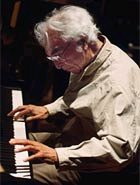
RAMSEY LEWIS


Ramsey Emmanuel Lewis, Jr. (born May 27, 1935 in Chicago, Illinois) is an American jazz and pop pianist and keyboardist.
He formed the Ramsey Lewis Trio in 1956 with Eldee Young and Isaac Holt. They started as primarily a jazz unit but after their hit, "The In Crowd", in 1965 (the single reached fifth place on the pop charts, and the album second place) the trio concentrated more and more on pop material. Young and Holt left in 1966 to form the Young-Holt Trio and were replaced by Cleveland Eaton and Maurice White. White was replaced by Maurice Jennings in 1970. In the late 1970s an additional keyboard player was frequently added to the lineup. A contemporary version of "The In Crowd" was recorded for Lewis' 2004 album, Time Flies.
Ramsey Lewis has received seven gold records and three Grammy Awards so far in his career.
His recent "With One Voice" release pays homage to his gospel roots all while maintaining his classic style. With the help of gospel favorites Smokie Norful, Darius Brooks, and Donald Lawrence, Lewis delivers an emotion-packed, soul-stirring, album. Lewis also enlisted the help of his church's choir, pastored by his older sister, to sing on several of the album's tracks. The J.W. James Memorial A.M.E. Church Combined Choir is breath-taking, adding so much life, freedom, and hope to "With One Voice". The CD's first single, "Pass Me Not" can be heard on Chicago's WGCI 107.5.
In addition to recording and performing, he is / has been a radio host on Chicago's Smooth Jazz station, WNUA (95.5 FM). His syndicated show Legends of Jazz, featuring classic jazz recordings from artists such as Charlie Parker and Miles Davis), can be heard in 60 cities in the United States and other countries as well. His most recent venture, the Legends of Jazz television series on PBS, was first aired in April 2006.
As of 2005 he has been hosting a radio show called Legends of Jazz for London's Smooth FM (previously Jazz FM).
On December 4, 2006, the Ramsey Lewis Morning Show will become a part of Broadcast Architecture's Smooth Jazz Network, simulcasting on other Smooth Jazz stations across the country for the first time. However, the show will still be based in Chicago, as it has always been.

August 17, 2007

LAMONT "Napalm" DIXON

Lamont Dixon, better known in the poetry world as "Napalm," was born and raised in Philadelphia, Pa along with three brothers. He graduated from John Bartram High School where he was an art major as well as captain of the track team. He served seven years in the United States Navy and is currently employed by the United States Postal Service as Cheif Union Representative.

Lamont mentors youth through many civic and arts based associations; with Masonic Lodges, the legendary Clef Club in Philadelphia and the Philadelphia Free Library. He also does community outreach thru prisons, homeless shelters, YMCA's and halfway houses. So you see, brother Lamont gives back to the community.

He has performed Spoken Word along side many Philadelphia jazz musicians including Byard lancaster, Khan Jamal, Warren oree and vocalist Denise King. He credits as his major poetic influence Amiri Baraka. Napalm writes all styles of poetry but the majority of which is influenced by Jazz.

He infuses jazz, hip hop, blues, and drama with his performances and workshops.
Napalm trained at Freedom Theater and the Phila. Univ. of the Arts, as well as a tenure with Temple U.'s Full Circle Improvisational Troupe. Napalm's poetry has been published in African Voices, The Phylaxis, New Poet's Revolution and Essence Magazine. _He is a recipient of the Phylaxis Society's Excellence in Literature Award and John G. Lewis Medal of Excellence for Art. Napalm is a teaching artist for Perkins Center for the Arts, the NJ & PA State Council for the Arts, and Rutgers and Rowan University.

Napalm appears on African Rhythm Tongues with jazz musicians Khan Jamal and Byard Lancaster, Po-Jazz Connection with Arpeggio Jazz ensemble and others.
He also served as co-executive producer for the Russell Simmon's 2001 Def Poetry Jam Tour in Philadelphia.

August 16, 2007

THELONIOUS MONK


Thelonious "Sphere" Monk was born on October 10, 1917, in Rocky Mount, North Carolina, but was only four when his mother and his two siblings, Marion and Thomas, moved to New York City. Unlike other Southern migrants who headed straight to Harlem, the Monks settled on West 63rd Street in the “San Juan Hill” neighborhood of Manhattan, near the Hudson River. His father, Thelonious, Sr., joined the family three years later, but health considerations forced him to return to North Carolina. During his stay, however, he often played the harmonica, ‘Jew’s harp,” and piano—all of which probably influenced his son’s unyielding musical interests. Young Monk turned out to be a musical prodigy in addition to a good student and a fine athlete. He studied the trumpet briefly but began exploring the piano at age nine. He was about nine when Marion’s piano teacher took Thelonious on as a student. By his early teens, he was playing rent parties, sitting in on organ and piano at a local Baptist church, and was reputed to have won several “amateur hour” competitions at the Apollo Theater.


Admitted to Peter Stuyvesant, one of the city’s best high schools, Monk dropped out at the end of his sophomore year to pursue music and around 1935 took a job as a pianist for a traveling evangelist and faith healer. Returning after two years, he formed his own quartet and played local bars and small clubs until the spring of 1941, when drummer Kenny Clarke hired him as the house pianist at Minton’s Playhouse in Harlem.
Minton’s, legend has it, was where the “bebop revolution” began. The after-hours jam sessions at Minton’s, along with similar musical gatherings at Monroe’s Uptown House, Dan Wall’s Chili Shack, among others, attracted a new generation of musicians brimming with fresh ideas about harmony and rhythm—notably Charlie Parker, Dizzy Gillespie, Mary Lou Williams, Kenny Clarke, Oscar Pettiford, Max Roach, Tadd Dameron, and Monk’s close friend and fellow pianist, Bud Powell. Monk’s harmonic innovations proved fundamental to the development of modern jazz in this period. Anointed by some critics as the “High Priest of Bebop,” several of his compositions (“52nd Street Theme,” “Round Midnight,” “Epistrophy” [co-written with Kenny Clarke and originally titled “Fly Right” and then “Iambic Pentameter”], “I Mean You”) were favorites among his contemporaries.


Yet, as much as Monk helped usher in the bebop revolution, he also charted a new course for modern music few were willing to follow. Whereas most pianists of the bebop era played sparse chords in the left hand and emphasized fast, even eighth and sixteenth notes in the right hand, Monk combined an active right hand with an equally active left hand, fusing stride and angular rhythms that utilized the entire keyboard. And in an era when fast, dense, virtuosic solos were the order of the day, Monk was famous for his use of space and silence. In addition to his unique phrasing and economy of notes, Monk would “lay out” pretty regularly, enabling his sidemen to experiment free of the piano’s fixed pitches. As a composer, Monk was less interested in writing new melodic lines over popular chord progressions than in creating a whole new architecture for his music, one in which harmony and rhythm melded seamlessly with the melody. “Everything I play is different,” Monk once explained, “different melody, different harmony, different structure. Each piece is different from the other. . . . [W]hen the song tells a story, when it gets a certain sound, then it’s through . . . completed.”


Despite his contribution to the early development of modern jazz, Monk remained fairly marginal during the 1940s and early 1950s. Besides occasional gigs with bands led by Kenny Clarke, Lucky Millinder, Kermit Scott, and Skippy Williams, in 1944 tenor saxophonist Coleman Hawkins was the first to hire Monk for a lengthy engagement and the first to record with him. Most critics and many musicians were initially hostile to Monk’s sound. Blue Note, then a small record label, was the first to sign him to a contract. Thus, by the time he went into the studio to lead his first recording session in 1947, he was already thirty years old and a veteran of the jazz scene for nearly half of his life. But he knew the scene and during the initial two years with Blue Note had hired musicians whom he believed could deliver. Most were not big names at the time but they proved to be outstanding musicians, including trumpeters Idrees Sulieman and George Taitt; twenty-two year-old Sahib Shihab and seventeen-year-old Danny Quebec West on alto saxophones; Billy Smith on tenor; and bassists Gene Ramey and John Simmons. On some recordings Monk employed veteran Count Basie drummer Rossiere “Shadow” Wilson; on others, the drum seat was held by well-known bopper Art Blakey. His last Blue Note session as a leader in 1952 finds Monk surrounded by an all-star band, including Kenny Dorham (trumpet), Lou Donaldson (alto), “Lucky” Thompson (tenor), Nelson Boyd (bass), and Max Roach (drums). In the end, although all of Monk’s Blue Note sides are hailed today as some of his greatest recordings, at the time of their release in the late 1940s and early 1950s, they proved to be a commercial failure.


Harsh, ill-informed criticism limited Monk’s opportunities to work—opportunities he desperately needed especially after his marriage to Nellie Smith in 1947, and the birth of his son, Thelonious, Jr., in 1949. Monk found work where he could, but he never compromised his musical vision. His already precarious financial situation took a turn for the worse in August of 1951, when he was falsely arrested for narcotics possession, essentially taking the rap for his friend Bud Powell. Deprived of his cabaret card—a police-issued “license” without which jazz musicians could not perform in New York clubs—Monk was denied gigs in his home town for the next six years. Nevertheless, he played neighborhood clubs in Brooklyn—most notably, Tony’s Club Grandean, sporadic concerts, took out-of-town gigs, composed new music, and made several trio and ensemble records under the Prestige Label (1952-1954), which included memorable performances with Sonny Rollins, Miles Davis, and Milt Jackson. In the fall of1953, he celebrated the birth of his daughter Barbara, and the following summer he crossed the Atlantic for the first time to play the Paris Jazz Festival. During his stay, he recorded his first solo album for Vogue. These recordings would begin to establish Monk as one of the century’s most imaginative solo pianists.


In 1955, Monk signed with a new label, Riverside, and recorded several outstanding LP’s which garnered critical attention, notably Thelonious Monk Plays Duke Ellington, The Unique Thelonious Monk, Brilliant Corners, Monk’s Music and his second solo album, Thelonious Monk Alone. In 1957, with the help of his friend and sometime patron, the Baroness Pannonica de Koenigswarter, he had finally gotten his cabaret card restored and enjoyed a very long and successful engagement at the Five Spot Café with John Coltrane on tenor saxophone, Wilbur Ware and then Ahmed Abdul-Malik on bass, and Shadow Wilson on drums. From that point on, his career began to soar; his collaborations with Johnny Griffin, Sonny Rollins, Art Blakey, Clark Terry, Gerry Mulligan, and arranger Hall Overton, among others, were lauded by critics and studied by conservatory students. Monk even led a successful big band at Town Hall in 1959. It was as if jazz audiences had finally caught up to Monk’s music.


By 1961, Monk had established a more or less permanent quartet consisting of Charlie Rouse on tenor saxophone, John Ore (later Butch Warren and then Larry Gales) on bass, and Frankie Dunlop (later Ben Riley) on drums. He performed with his own big band at Lincoln Center (1963), and at the Monterey Jazz Festival, and the quartet toured Europe in 1961 and Japan in 1963. In 1962, Monk had also signed with Columbia records, one of the biggest labels in the world, and in February of 1964 he became the third jazz musician in history to grace the cover of Time Magazine.


However, with fame came the media’s growing fascination with Monk’s alleged eccentricities. Stories of his behavior on and off the bandstand often overshadowed serious commentary about his music. The media helped invent the mythical Monk—the reclusive, naïve, idiot savant whose musical ideas were supposed to be entirely intuitive rather than the product of intensive study, knowledge and practice. Indeed, his reputation as a recluse (Time called him the "loneliest Monk") reveals just how much Monk had been misunderstood. As his former sideman, tenor saxophonist Johnny Griffin, explained, Monk was somewhat of a homebody: "If Monk isn't working he isn't on the scene. Monk stays home. He goes away and rests." Unlike the popular stereotypes of the jazz musician, Monk was devoted to his family. He appeared at family events, played birthday parties, and wrote playfully complex songs for his children: "Little Rootie Tootie" for his son, "Boo Boo's Birthday" and “Green Chimneys” for his daughter, and a Christmas song titled “A Merrier Christmas.” The fact is, the Monk family held together despite long stretches without work, severe money shortages, sustained attacks by critics, grueling road trips, bouts with illness, and the loss of close friends.


During the 1960s, Monk scored notable successes with albums such as Criss Cross, Monk’s Dream, It’s Monk Time, Straight No Chaser, and Underground. But as Columbia/CBS records pursued a younger, rock-oriented audience, Monk and other jazz musicians ceased to be a priority for the label. Monk’s final recording with Columbia was a big band session with Oliver Nelson’s Orchestra in November of 1968, which turned out to be both an artistic and commercial failure. Columbia’s disinterest and Monk’s deteriorating health kept the pianist out of the studio. In January of 1970, Charlie Rouse left the band, and two years later Columbia quietly dropped Monk from its roster. For the next few years, Monk accepted fewer engagements and recorded even less. His quartet featured saxophonists Pat Patrick and Paul Jeffrey, and his son Thelonious, Jr., took over on drums in 1971. That same year through 1972, Monk toured widely with the "Giants of Jazz," a kind of bop revival group consisting of Dizzy Gillespie, Kai Winding, Sonny Stitt, Al McKibbon and Art Blakey, and made his final public appearance in July of 1976. Physical illness, fatigue, and perhaps sheer creative exhaustion convinced Monk to give up playing altogether. On February 5, 1982, he suffered a stroke and never regained consciousness; twelve days later, on February 17th, he died.


Today Thelonious Monk is widely accepted as a genuine master of American music. His compositions constitute the core of jazz repertory and are performed by artists from many different genres. He is the subject of award winning documentaries, biographies and scholarly studies, prime time television tributes, and he even has an Institute created in his name. The Thelonious Monk Institute of Jazz was created to promote jazz education and to train and encourage new generations of musicians. It is a fitting tribute to an artist who was always willing to share his musical knowledge with others but expected originality in return.

August 12, 2007

The Partnership of Music and Poetry by María Teresa Fusari Buenos Aires, Argentina

The following article was posted on myspace by a regular listener of "Spotlight On Jazz And Poetry." I wanted to share this with everyone because it made me feel just that good about what people feel about my program;


Much has been said about the partnership of music and poetry. It is not new to say that they were born together; both of them are artistic expressions and they arise from the same feelings following established patterns, that being rhythm, which is common to both of them.

Consequently, it is not strange that some teachers approach poetry teaching through classical music. They encourage their students to listen to classical pieces to help them find the way to writing and, most of all, to pick up rhythm.

It is not new either, the fact that many people have united music and literature by setting poems to music Ranging from the biblical psalms to poems by Byron, Walt Whitman, William Blake, WB. Yeats, Emily Dickinson, Wallace Stevens, Antonio Machado, Mario Benedetti, Pablo Antonio Cuadra, Ernesto Cardenal, Joaquín Pasos, among others.

I would call this ability of getting a successful blending of poetry and music, an expression of art in itself.

Here is when Clayton Corley becomes an artist, when assembling the poem and the appropriate melody. He does not only provide entertainment but he also exposes us to different poets and their work, returning to the origin of poetry, when it was popular –Homer and the Troubadours – and not a bookish art as it has become in more modern times.

Moreover, he also contributes to education in other ways. As an ESL teacher (English as a second language teacher) I find Clayton Corley´s programme “Spotlight on Jazz and Poetry” a very useful tool to expose my students to native speaking and general culture by making them listen. In that way, main ideas coming from the poem are discussed, to end up by commenting on the jazz piece that served as background and complement.

What else may I say about “Spotlight on Jazz and Poetry”? I have only praises for him; admiration for his work of great quality and gratitude for letting us enjoy it.

July 23, 2007

DENISE KING

One day a shy girl from Philadelphia, PA, was sweeping her front stoop and sweetly singing "Summertime” when a guitarist/writer from Philadelphia International Records walked by and heard her singing. He was so impressed by what he heard that he auditioned her, hired her and the rest is history. That was the beginning of a singing career that would WOW people in Brazil, France, Africa, Japan, Turkey, and other places around the world.

Denise King was born and raised in West Philadelphia and is a graduate of West Philly High School. Denise is not only one of the best voices on the Jazz scene today, she strongly believes in giving back to the community. Through programs such as Be-Bop and Books (A literacy program for children) and A Performing Arts Program (which will cover Dance, Theater, Music, Painting and Quilting) and the Cedar Park Jazz Series which takes place on Friday evenings on 50th & Baltimore Aves in West Philly. The grand aim of all of these programs is to bridge the gap between our younger generation, our more established citizens and the variety of cultures which make up our neighborhood. Denise says "West Philly is rich in history and culture and a wide variety of people make up this wonderful community, Jazz is a great medium for communication!"

With no formal vocal instruction, it’s apparent that she was born to sing. She was introduced to Jazz at age twelve by an uncle who had an extensive collection of Jazz LP's. Her "studies" involved hours of listening to the Jazz greats, both vocalists and instrumentalists. Denise borrowed phrasing styles from Sarah Vaughan, Ella Fitzgerald, Nat "King" Cole and Frank Sinatra. She gained an appreciation for lyrics from Lil Jimmy Scott, Nancy Wilson, Carmen McCrae and Nina Simone. The early gigs were difficult in that she was painfully stage shy. But with the help of Sam Reed, sax man and leader of the legendary Uptown Theater Orchestra she overcame her stage fright. Her early experiences involved sharing the stage with many legends, Butch Ballard, Arthur Harper, Sam Dougherty, Cecil Payne, Jymie Merritt, Bootsie Barnes, Lex Humphries and many, many more. They taught her the importance of having something to say every time she stepped up to the microphone. Their instruction paid off. While performing at Zanzibar Blue in Philly, Denise met Dexter Wansel, writer, producer, which opened the door to many recording experiences at Philly International Records. Denise King is a very passionate singer who has a way of pulling her audiences into her performances.

Listening to her warm tone, impeccable phrasing, and the absolute control she has of her voice is mesmerizing. Whether she's singing a Billie Holiday, Ella Fitzgerald or Sarah Vaughan standard, or a Gladys Knight or Aretha Franklin cover, she puts her heart and soul into every note. Denise has mastered the art of making a song her own no matter what the genre. Over the years, she has shared the stage with such greats as Roy Hargrove, The Brecker Brothers, Phil Wright, Cecil McBee, Christian McBride, Orrin Evans, Lonnie Plaxico, Uri Caine, Sid Simmons, Dr. Guy Ramsey, J.D. Walter, Barbara Morrison, Derrick Hodge, Chris Beck, Billy Paul, Jean Carne, Celine Dion, Bunny Sigler and the list goes on and on. When performing with her band whether trio, quartet or quintet they are the driving force behind her and support her every note. They instinctively know what she's going to do next and meet her there with perfect timing. With a voice described as velvet smooth she captivates you and holds you with every note. When she's in concert, it's not unusual to see her break out into a dance on stage or with someone from the audience. Her shows are always energetic, fun and spontaneous. Her love of people, performance style, and energy are sure to always make Denise King a favorite at any venue.

Denise sings pop and jazz standards with touches of the blues, soul and even gospel in a voice steeped in a sophisticated, swinging, sometimes soulful, satin style much like one of her idols, Sarah Vaughan.
Her group includes: Aaron Graves, piano; Lee Smith, bass; Lucky Thompson, drums; Sam Reed, tenor-alto sax and Napoleon Black, percussion; a winning hand in any jazz club.

A singer, who cares about the song, Ms King said: "I am a sucker for the lyrics and not interested in vocal gymnastics. I want to hear the story the writer has to tell." And for this, those who share King"s love of Gershwin and Porter, can only be thankful. Some of her favorites: The Nearness of You, Poor Butterfly, Fever, Stolen Moments and Crazy. Her own favorite singers include: Sarah, Ella Fitzgerald, Peggy Lee, King Cole, Nancy Wilson, Sinatra and, yes, even Patsy Cline.
Ms King has sung at almost all the top clubs in Philadelphia and several in New York, Paris and Japan during the past 15 years. She started in her thirties and has expanded beyond singing into Denise King Enterprises producing concerts, records and dates for herself and others. Among her childhood influences were an uncle's jazz and blues record collection and Sid Mark's weekly radio marathon of Sinatra stylings. She says now, simply, "I loved gospel, blues, jazz, pop, Sinatra and R&B stars such as Ruth Brown and Ko Ko Taylor." She sums it all up saying, "I think I am a universal spirit."

July 22, 2007

BARBARA MONTGOMERY

Barbara Montgomery has been in the entertainment field for over thirty years as a music industry executive, publisher, producer, songwriter, arranger, recording artist, as well as working in production for film and television. She began performing as a jazz vocalist in 1970 but took a detour in her music career by joining the NBC/Westinghouse television station that produced the “Mike Douglas Show”, working for that program and others. The days on the Douglas Show were priceless, for she worked side by side with the greats in jazz--Ella Fitzgerlad, Tony Bennett, Lionel Hampton, Woody Herman, to name just a few. During this time she also freelanced, working on the seminal PBS series, “The Constitution: That Delicate Balance”, as well as touring as a lighting designer for international popular music groups. She was also the managing director of a major recording studio servicing the music, television and film businesses.

She has been Music Director for Richard Simmons since 1986. This has given her the opportunity to produce the music for over 20 exercise videos ranging from oldies to disco to Broadway to Latin music, working in studios from New York to Los Angeles with hundreds of world class studio musicians.

After a twenty-year break, she returned to her passion, performing and recording as a jazz musician. Her relationship with Chick Corea and Neville Potter led to her third CD “Dakini Land” and was a springboard for the original songs on her fourth CD “Little Sunflower”. This endeavour blessed her with the gift of friendship, performance, and collaboration with the great jazz trumpeter Freddie Hubbard. She has produced six CDs of her own, arranging and writing original material for five of them in collaboration with Steve Giordano (“Ask Me Now”), Barry Sames (“Dakini Land” and “Little Sunflower”) and Aaron Graves (“Trinity”). Her 2005 release, “Trinity” was co-produced with pianist/composer/ arranger Aaron Graves, whose short list includes work with Stanley Turrentine, Cassandra Wilson, Dakota Staton, the legendary Jimmy Scott, and Oscar Brown, Jr. Both “Little Sunflower” and “Trinity” were honored with the Blue Chip Award for Best Jazz Vocals by Dr. Herb Wong of the International Association of Jazz Educators.

Ms. Montgomery also leads LADIES NIGHT OUT, her band of top female jazz musicians including Monette Sudler on guitar, Lynn Riley on saxophones/flute/clarinet, Lee-sa Robinson on drums, all international recording artists and performers in their own right.

She has been asked to write and contribute for jazz publications, including the premier issue of the AllAboutJazz newspaper, Jazziz Magazine, and Downbeat, and was featured in the July 2004 issue of Jazziz. She is writing a book on life as a private citizen in Saigon during the Vietnam War.

While raising her two children, she performed primarily in the PA/DE/NJ/NY area (Iridium, Borgia Cafe, Zanzibar Blue, Ortlieb's, Chris' Cafe, jazz festivals, Philadelphia Museum of Art Jazz Series among others); has had three sold out tours in Slovakia and the Czech Republic, performing in Prague, Usti nad Labem, Olomousc, Bratislava, Trencin, Piestany, Banska Biasnica, Martin, Zvolen, Banska Biastryka; and has performed often in France.

She has been volunteering with The Institutes for the Achievement of Human Potential, an international institute that works with the families of brain injured children, since 1980, in their programs for hurt kids and well children. She home schooled her two children (now 27 and 19) from birth via the neurological program guidelines of the Institutes, teaching languages, art, music, violin, sciences, history, literature, and gymnastics among other areas in the academic and physical programs; became certified at the teaching level; has volunteered for many years in their clinical work, most recently proving translation services for the French speaking families; participated in over 20 twenty world meetings on brain research. She has received the Brazilian Gold Medal of Honor for her efforts in this field.

She is deeply involved in gun violence prevention, stemming from the years she lived in South Vietnam in the early 1960's. A more recent tragedy was the murder-suicide in January 2002 in Ardmore, Pa. of the family of five that included her daughter's dear friend, 14-year-old Alexandra Wake. Since that time she has hosted town meetings to address the dilemma of gun accessibility, has spoken at press conferences state wide, and has lobbied often in the Pennsylvania state capitol and in Congress in Washington, D.C. This led her to become the President of The Pennsylvania Million Mom Chapters of the Brady Campaign. She continuously presents s gun violence prevention workshops to youth in middle schools, high schools, community organizations, and colleges; produced a state-wide assault weapons ban conference in the spring of 2004; and has testified in front of and advised the City Council of Philadelphia and the Pa. State Senate on firearms legislation.

She also works with Mothers in Charge and Mothers Opposed to Murder, both groups of Philadelphia mothers who have lost children to homicide, as well as Mantua Against Drugs, Men United for a Better Philadelphia, Pennsylvanians Against Trafficking Handguns, and other grass roots organizations in Pennsylvania. From October 2004 through 2005 she directed weekly workshops with teens using music as the vehicle to help them work through the violence in their lives, coaching them to write poetry, song lyrics, and music, as well as coaching actual performances of their songs. She performed at the national Million Mom March on Mother’s Day of 2004 in Washington, D.C. on the west lawn of the Capitol honoring Alexandra and the many victims of gun violence, and each year produces and performs the Mother’s Day Remembrance Service for the Pennsylvania Million Mom March.

July 21, 2007

SEKOU SUNDIATA


Blues, jazz, funk, and Afro-Caribbean percussion surround the soulful voice of Harlem-born poet Sekou Sundiata on his recordings, The Blue Oneness of Dreams and Longstoryshort. His words speak of black culture and tradition, often with a political edge. "People be droppin’ revolution like it was a pick-up line," he says in Longstoryshort. "You wouldn’t use that word if you knew what it meant."

S ekou Sundiata, (born Robert Feaster), was born on August 22, 1948, in Harlem, New York. Sekou taught English literature at the New School for Social Research, Sundiata became quite a performer in his own right as well, usually leading a band on frequent club dates reminiscent of June Jordan, Amiri Baraka (Leroi Jones), and Quincy Troupe. Sundiata began writing for the musical theater, and premiered The Mystery of Love in 1994, with songwriting help from Doug Booth. The duo also teamed up on Sundiata's debut album, The Blue Oneness of Dreams, with Booth contributing both songs and his soulful vocals to the project. The album was released on Polygram in 1997; A Long Story Short followed in early 2000.

Sundiata recorded and performed his poetry with such renowned musicians as Craig Harris, David Murray, Nona Hendryx, and Vernon Reid. However, he did not consider himself a performance poet. "This thing about spoken word artists and performance poets, " he said in a 2003 interview, "I think of it mainly as marketing categories. I’m satisfied with just calling myself a poet."

His designation as a poet also satisfied New York City's New School University, where Sundiata was the first Writer-in-Residence. He taught literature and poetry classes, despite never having published a book of poems. Among his students was folk-rocker Ani DiFranco, whose Righteous Babe label released Longstoryshort. DiFranco has said that Sundiata "taught me everything I know about poetry. " The two performed together in twenty-three cities during her "Rhythm and News Tour" in 2001.
Despite touring and performing with musicians, Sundiata didn't consider himself a "crossover" artist. For him, being a poet necessarily implied a deep engagement with several genres. "It's damn near impossible to understand what contemporary black poets are doing without understanding what's going on with black music and its relationship to black speech and black literature, " he said.

In 2003, Sundiata toured the United States again, performing his one-man theatrical piece Blessing the Boats, a chronicle of his five-year battle with kidney failure, and his eventual recovery thanks to a transplant donated by his friend and manager Katea Stitt, daughter of jazz saxophonist Sonny Stitt. The piece blends monologues, readings, stand-up comedy, spoken word, and storytelling with recorded music and video projections.

The poet's most recent theatrical piece, The America Project, contemplating America's place in the world, featured poems and a cycle of songs, accompanied by images and a ten-member ensemble of musicians and vocalists.
Television journalist Bill Moyers, who featured Sundiata in the PBS series on poetry, The Language of Life, has said of the poet: "His music comes from so many places it is impossible to name them all. But I will wager that if we could trace their common origin, we'd arrive at the headwaters of the soul. Listen carefully and he’ll take you there."

Sundiata died of heart failure early in the morning on July 18th, 2007.

July 08, 2007

GERALD L. CANNON


Gerald L. Cannon, Musician, composer, and artist was born in Racine, Wisconsin, and is a true-life 21st century Renaissance man. For that reason one should not confuse his craft with anything but genuine, from the heart artistry.

Gerald's initial inspiration was his father Benjamin, a guitarist, who bought him his first electric bass at 10 years old. At 16 he began playing bass in his father's own group, The Gospel Expressions. Gerald attended the University of Wisconsin at Lacrosse, where he met jazz great Milt Hinton. This meeting changed not only Gerald's major in college, but also the rest of his life.

At 19 Gerald transferred to the Wisconsin Conservatory of Music in Milwaukee, where he studied jazz/classical bass and piano. He also studied art at Marquette University, which nurtured a natural talent and love of painting. Outside of school, Gerald began working as musical director for vocalist Penny Goodwin, who ultimately became his single greatest mentor. This experience, combined with the subsequent creation of his own quintet Gerald Cannon's Jazz Elements, laid the foundation for a solid reputation as a leader and composer in his own right.

In Spring of 1988 Gerald moved to New York City and began working with some of the most significant jazz artists of our time, including Art Blakey, Dexter Gordon, Cedar Walton, Billy Higgins, Jimmy Smith, Frank Foster, Little Jimmy Scott, Von Freeman, Stanley Turrentine and Bunky Green. An introduction to Roy Hargrove in 1995 lead to an historic collaboration that achieved national and international success, culminating in the contribution of Gerald's original composition Peri to Hargrove's recording Moment to Moment (Verve).

In 2001, Gerald left Hargrove to join the legendary drummer Elvin Jones. "Playing with Elvin is like going back to school. He continually challenges my creativity." When not working with Elvin, Gerald fills the bass chair of the Cannonball Adderly Reunion Band with Louis Hayes. "His (Louis') sense of swing is unbelievable."

Gerald carries the knowledge passed on to him by legendary bassists such as Ray Brown and Sam Jones, and continues the legacy by conducting master classes throughout the U.S. and Europe. The consummate sideman, musical director, composer, educator, painter and producer, Gerald has now stepped out front as leader with the debut of his self-titled recording Gerald Cannon (Woodneck Records) in 2004.

Like the masters before him, Gerald Cannon has established a fearless, solid groove that distinguishes him as one of the principal figures in jazz.

July 07, 2007

TSHOMBE HARRIS


Tshombe Sekou Harris, who goes by the name Truth Theory was born April 18, 1973 in New Orleans, La. He wrote his first piece of literature in July of 2006 as a release of emotions, and continued on to write poetry. With this new found affinity for poetry combined with his love for music, he began composing tracks to flow with his written words. It was at this time he created the moniker of Truth Theory. After getting much feedback on his blogs in places like blogger, MySpace, and multiply.com, he was encouraged to continue in his craft for words and music.

After much writing, he eventually recorded his written poetry pieces for the first time in the form of a spoken word album titled "IAMNOTAPO3T" which can be purchased at CDbaby.com, an album he self produced and published as an indie artist for raising funds for his self established scholarship “The Truth Theory African American Heritage Scholarship” that is given out bi-annually to young under privileged African-Americans looking to go on to college, to find more on the scholarship you can visit www.truththeory.com.

He continues to write poetry occasionally as a form of release while managing an online poetry group "Po3tic Voices" a group of 55 poets moving to harness their skills in the spoken word realm, hear more about poetic voices at www.po3ticVoices.multiply.com. He also hosts an online spoken word talk show "Spoken Truth" over on www.blogtalkradio.com and soon here on NAL Radio, this talk show is designed for “Indie” artist to share some of their works and for providing a forum for discussing some of the issues in our community. He does all of this as he furthers his career in the US Navy and completes his Degree in Computer Engineering. He is also currently working on his second and third CD, which he is hoping to complete by the summer of 2008.

"In my opinion," Tshombe says, "poetry and jazz are one in the same in that they both are rhythmic and free flowing. Poetry is image forming and thought provoking, it allows the reader/listener to use their mind as a canvas to generate their own experiences as well as new emotions. Well, non-vocalized jazz does this very thing—it takes you to heights, new levels of highs and lows. So jazz and poetry, together are a sure fire cocktail for a mind altering experience."

July 06, 2007

JOHN COLTRANE


John Coltrane was born September 23, 1926 in Hamlet North Carolina and grew up in High Point, North Carolina, where he learned to play E-flat alto horn, clarinet, and (at about the age of 15) alto saxophone. After moving to Philadelphia he enrolled at the Ornstein School of Music and the Granoff Studios; service in a navy band in Hawaii (1945-46) interrupted these studies. He played alto saxophone in the bands led by Joe Webb and King Kolax, then changed to the tenor to work with Eddie "Cleanhead" Vinson (1947-48). He performed on either instrument as circumstances demanded while in groups led by Jimmy Heath, Howard McGhee, Dizzy Gillespie (with whom he made his first recording in 1949), Earl Bostic, and lesser-known rhythm-and-blues musicians, but by the time of his membership in Johnny Hodges's septet (1953-54) he was firmly committed to the tenor instrument. He performed infrequently for about a year, then leaped to fame in Miles Davis' quintet with Red Garland, Paul Chambers, and Philly Joe Jones (1955-57). Coltrane was, after Charlie Parker, the most revolutionary and widely imitated saxophonist in jazz.

Throughout the 1950s addiction to drugs and then alcoholism disrupted his career. Shortly after leaving Davis, however, he overcame these problems; his album A Love Supreme celebrated this victory and the profound religious experience associated with it. Coltrane next played in Thelonious Monk's quartet (July-December 1957), but owing to contractual conflicts took part in only one early recording session of this legendary group. He rejoined Davis and worked in various quintets and sextets with Cannonball Adderley, Bill Evans, Chambers, Jones, and others (1958-60). While with Davis he discovered the soprano saxophone, purchasing his own instrument in February 1960.

Having led numerous studio sessions, established a reputation as a composer, and emerged as the leading tenor saxophonist in jazz, Coltrane was now prepared to form his own group; it made its debut at New York's Jazz Gallery in early May 1960. After briefly trying Steve Kuhn, Pete La Roca, and Billy Higgins, Coltrane hired two musicians who became longstanding members of his quartet, McCoy Tyner (1960-65) and Elvin Jones (1960-66); the third, Jimmy Garrison, joined in 1961. With these sidemen the quartet soon acquired an international following. At times Art Davis added a second double bass to the group; Eric Dolphy also served as an intermittent fifth member on bass clarinet, alto saxophone, and flute from 1961 to 1963, and Roy Haynes was the most regular replacement for Elvin Jones during the latter's incarceration for drug addiction in 1963.

Coltrane turned to increasingly radical musical styles in the mid-1960s. These controversial experiments attracted large audiences, and by 1965 he was surprisingly affluent. From autumn 1965 his search for new sounds resulted in frequent changes of personnel in his group. New members included Pharoah Sanders, Alice Coltrane (his wife), Rashied Ali (a second drummer until Jones' departure), several drummers as seconds to Ali, and a number of African-influenced percussionists. In his final years and after his death, Coltrane acquired an almost saintly reputation among listeners and fellow musicians for his energetic and selfless support of young avant-garde performers, his passionate religious convictions, his peaceful demeanor, and his obsessive striving for a musical ideal. He crossed over at the age of 40 July 17, 1967 at Huntington Hospital in Long Island NY of a liver ailment. A videotape tracing his development, The Coltrane Legacy, produced by David Chertok and Burrill Crohn, was issued in 1987.

July 05, 2007

AMIRI BARAKA


Amiri Baraka, born in 1934, in Newark, New Jersey, USA, is the author of over 40 books of essays, poems, drama, and music history and criticism, a poet icon and revolutionary political activist who has recited poetry and lectured on cultural and political issues extensively in the USA, the Caribbean, Africa, and Europe.

With influences on his work ranging from musical orishas such as Ornette Coleman, John Coltrane, Thelonius Monk, and Sun Ra to the Cuban Revolution, Malcolm X and world revolutionary movements, Baraka is renown as the founder of the Black Arts Movement in Harlem in the 1960s that became, though short-lived, the virtual blueprint for a new American theater aesthetics. The movement and his published and performance work, such as the signature study on African-American music, Blues People (1963) and the play Dutchman (1963) practically seeded “the cultural corollary to black nationalism” of that revolutionary American milieu.

Other titles range from Selected Poetry of Amiri Baraka/LeRoi Jones (1979), to The Music (1987), a fascinating collection of poems and monographs on Jazz and Blues authored by Baraka and his wife and poet Amina, and his boldly sortied essays, The Essence of Reparations (2003).

The Essence of Reparations is Baraka’s first published collection of essays in book form radically exploring what is sure to become a twenty-first century watershed movement of Black peoples to the interrelated issues of racism, national oppression, colonialism, neo-colonialism, self-determination and national and human liberation, which he has long been addressing creatively and critically. It has been said that Amiri Baraka is committed to social justice like no other American writer. He has taught at Yale, Columbia, and the State University of New York at Stony Brook.

Somebody Blew Up America & Other Poems is Baraka’s first collection of poems published in the Caribbean and includes the title poem that has headlined him in the media in ways rare to poets and authors. The recital of the poem “that mattered” engaged the poet warrior in a battle royal with the very governor of New Jersey and with a legion of detractors demanding his resignation as the state’s Poet Laureate because of Somebody Blew Up America’s provocatively poetic inquiry (in a few lines of the poem) about who knew beforehand about the New York City World Trade Center bombings in 2001.

The poem’s own detonation caused the author’s photo and words to be splashed across the pages of New York’s Amsterdam News and the New York Times and to be featured on CNN--to name a few US city, state and national and international media.

Baraka lives in Newark with his wife and author Amina Baraka; they have five children and head up the word-music ensemble, Blue Ark: The Word Ship and co-direct Kimako’s Blues People, the “artspace” housed in their theater basement for some fifteen years.

His awards and honors include an Obie, the American Academy of Arts & Letters award, the James Weldon Johnson Medal for contributions to the arts, Rockefeller Foundation and National Endowment for the Arts grants, Professor Emeritus at the State university of New York at Stony Brook, and the Poet Laureate of New Jersey.

July 04, 2007

MARY LOU WILLIAMS

Mary Lou Williams, born Mary Elfrieda Scruggs on May 8, 1910 in Atlanta, GA (although she soon took the name of her stepfather and was known as Mary Lou Burley), she taught herself the piano by ear and was playing in public at the age of six. Growing up in Pittsburgh, Williams' life was always filled with music. When she was 13, she started working in vaudeville, and three years later married saxophonist John Williams. They moved to Memphis, and she made her debut on records with Synco Jazzers. John soon joined Andy Kirk's orchestra, which was based in Kansas City, in 1929. Williams wrote arrangements for the band, filled in for an absent pianist on Kirk's first recording session, and eventually became a member of the orchestra herself. Her arrangements were largely responsible for the band's distinctive sound and eventual success. Williams was soon recognized as Kirk's top soloist, a stride pianist who impressed everyone (even Jelly Roll Morton). In addition, she wrote such songs such as "Roll 'Em" (a killer hit for Benny Goodman) and "What's Your Story Morning Glory" and contributed arrangements to other big bands, including those of Goodman, Earl Hines, and Tommy Dorsey.

To say that Mary Lou Williams had a long and productive career is an understatement. Although for decades she was often called jazz's greatest female musician (and one has to admire what must have been a nonstop battle against sexism), she would have been considered a major artist no matter what her sex.
Just the fact that Williams and Duke Ellington were virtually the only stride pianists to modernize their style through the years would have been enough to guarantee her a place in jazz history books. Williams managed to always sound modern during a half-century career without forgetting her roots or how to play in the older styles.

Mary Lou Williams stayed with Kirk until 1942, by which time she had divorced John Williams and married trumpeter Harold "Shorty" Baker. She co-led a combo with Baker before he joined Duke Ellington. Williams did some writing for Duke (most notably her rearrangement of "Blue Skies" into a horn battle called "Trumpets No End") and played briefly with Benny Goodman's bebop group in 1948. She had gradually modernized her style and by the early to mid-'40s was actively encouraging the young modernists who would lead the bebop revolution, including Thelonious Monk, Bud Powell, Tadd Dameron, and Dizzy Gillespie. Williams' "Zodiac Suite" showed off some of her modern ideas, and her "In the Land of Oo-Bla-Dee" was a bebop fable recorded by Gillespie.

Williams lived in Europe from 1952-1954 and then became very involved in the Catholic religion. She retired from music for a few years before appearing as a guest with Dizzy Gillespie's orchestra at the 1957 Newport Jazz Festival. Williams returned to jazz and by the early '70s sounded more like a young modal player (clearly she was familiar with McCoy Tyner) than a survivor of the 1920s. Although she did not care for the avant-garde, she occasionally played quite freely, although a 1977 duo concert with Cecil Taylor was a complete fiasco. Williams wrote three masses and a cantana, was a star at Benny Goodman's 40th-anniversary Carnegie Hall concert in 1978, taught at Duke University, and often planned her later concerts as a history of jazz recital. By the time she crossed over on May 28, 1981 in Durham, NC at the age of 71, she had a list of accomplishments that could have filled three lifetimes.

Mary Lou Williams recorded through the years as a leader for many labels including Brunswick (a pair of piano solos in 1930), Decca (1938), Columbia, Savoy, extensively for Asch and Folkways during 1944-1947, Victor, King (1949), Atlantic, Circle, Vogue, Prestige, Blue Star, Jazztone, her own Mary label (1970-1974), Chiaroscuro, SteepleChase, and finally Pablo (1977-1978).

July 03, 2007

MARGARET WALKER


Margaret Abigail Walker was born on July 7 1915 in Birmingham, Alabama. Her parents, the Reverend Sigismund C. Walker, a Methodist minister and an educator, and Marion Dozier Walker, a music teacher, encouraged her to read poetry and philosophy from an early age.
Walker completed her high school education at Gilbert Academy in New Orleans, Louisiana, where her family had moved in 1925. She went on to attend New Orleans University (now Dillard University) for two years. Then, after acclaimed poet Langston Hughes recognized her talent and urged her to seek training in the North, she transferred to Northwestern University in Chicago, Illinois, where she received a B.A. in English in 1935, at the age of nineteen. In 1937, she published "For My People" in Poetry magazine. Her first poem to appear in print, “For My People” became one of her most famous works and was even anthologized in 1941 in The Negro Caravan.

In 1936, Walker took on full-time work with the Federal Writers' Project in Chicago under Franklin D. Roosevelt's Works Project Administration, befriending and collaborating with such noted artists as Gwendolyn Brooks, Katherine Dunham, and Frank Yerby. Perhaps the most memorable of these friendships was that with noted author Richard Wright whose texts Walker would later help to research and revise. In 1988, Walker wrote a book recalling that friendship, entitled Richard Wright, Daemonic Genius: A Portrait of the Man, a Critical Look at His Work. Involvement in the Writers' Project offered Walker a firsthand glimpse of the struggles of inner-city African Americans who were products of the Great Migration, a northward movement that had resulted in hard times and broken dreams for many southern black immigrants. During this time, Walker authored an urban novel, "Goose Island," which was never published.

After completing her tenure with the WPA in 1939, Walker returned to school, entering the Creative Writing Program at the University of Iowa, where she earned a Master of Arts degree in 1940 and, later, a Ph.D. in 1965. In 1941, Walker began teaching at Livingstone College in Salisbury, North Carolina. In 1942, she left for one year to teach at West Virginia State College. In that year, she also published her first volume of poems, For My People, with the title poem quickly becoming her signature piece and helping elevate her toward success. For this volume, which served as her Master's thesis at Iowa, she won the Yale Younger Poets Award.
In 1943, Walker married Firnist James Alexander, or "Alex," as she lovingly called him, an interior designer and decorator. In 1949, following the birth of their first three children (they had a total of four children), the couple moved to Jackson, Mississippi. Walker began a prosperous teaching career at Jackson State College in the same year, retiring from its English Department thirty years later in 1979. In 1968, she founded the Institute for the Study of History, Life, and Culture of Black People (now the Margaret Walker Alexander National Research Center). She directed the center until her retirement. During her tenure at Jackson State, Walker also organized and chaired the Phillis Wheatley Poetry Festival.

Following retirement, she remained active as professor emerita until she crossed over on November 30, 1998 from breast cancer. Jubilee, a neo-slave narrative based on the collected memories of the author’s maternal grandmother, Elvira Ware Dozier, was published in 1966, only a year after Walker completed the first version of it for her dissertation. Many scholars view the novel as an African American response to America's fascination with Gone With the Wind (1936). Others recognize the work as an example of the historic presence that the author commands as a prophet of sorts for her people. The novel has enjoyed tremendous popularity, winning the Houghton Mifflin Literary Award (1968), having been translated into seven languages, and having never gone out of print. It has also led the author into controversy: in 1988, Walker found herself in conflict with the famed author of Roots, Alex Haley, whom she accused of infringing on her copyright of Jubilee. However, her lawsuit against him was dismissed. Walker provides further detail regarding the production of the novel in her 1972 essay, "How I Wrote Jubilee."

Walker followed Jubilee with Prophets for a New Day (1970), a poetic treatment of the historic civil rights struggle of blacks in America. It also celebrates the tradition of African American folktales and expression.
Although October Journey (1973) is more personal in tone, it still resonates with Walker's commitment to highlight the black race's struggle for freedom through art. The poems of the collection pay homage to many of Walker’s contemporaries, such as Gwendolyn Brooks and Robert Hayden, who also employed their art as tools of liberation.

Walker's influence on the younger Black Aesthetic poets of the 1960s and 1970s can be seen in her published talks with Nikki Giovanni. Appearing in 1974, A Poetic Equation: Conversations between Nikki Giovanni and Margaret Walker exemplifies the common concern for justice that linked the two artists and bridged their generations.
ForFarish Street Green, Walker’s fourth poetry volume, appeared in 1986. Pieces in this collection reflect life in the Farish Street community in Jackson, Mississippi. Walker begins her portrait of the people in the neighborhood by making their lives testaments to those of their African ancestors.

This Is My Century: New and Collected Poems (1989) chronicles Walker's auspicious literary career while proving that she has unrivaled tenacity and endurance as a poet. In 1990, she revised and re-published How I Wrote Jubilee and Other Essays on Life and Literature, coauthored with scholar Maryemma Graham. In 1997, with Graham as editor again, Walker released another collection of previously written essays, entitled On Being Female, Black, and Free: Essays by Margaret Walker, 1932-1992. Several other projects remained incomplete at the time of Walker’s death, including "God Touched My Life," a biography of Sister Thea Bowman, a black nun in Mississippi; "Black-Eyed Susans," an account of the murders of two students at Jackson State College; a book on Jesse Jackson's relationship to black politics; and an autobiography.

Among Walker's numerous accolades are six honorary degrees, a Rosenwald Fellowship (1944), a Ford Fellowship (1953), a Fulbright Fellowship to Norway (1971), a senior fellowship from the National Endowment for the Humanities (1972), the Living Legacy Award, given by the Carter administration, the Lifetime Achievement Award of the College Language Association (1992), and the Lifetime Achievement Award for Excellence in the Arts, presented by William Winter, then governor of Mississippi (1992).

Walker has been compared to many great writers and has claimed, as personal acquaintances and influences, the likes of James Weldon Johnson, Langston Hughes, and Gwendolyn Brooks. Longevity was Walker’s friend, and, over the course of her career, she earned a place among the best (African) American poets, many of whom were her protégés.

June 26, 2007

DAVE BRUBECK

Dave Brubeck was born in Concord, California, on December 6, 1920. He was the third son of Elizabeth Ivey Brubeck, a music teacher and pianist, and Howard "Pete" Brubeck, a cattle rancher. Dave went to the College of the Pacific, in Stockton, California, as a pre-med student with the aim of becoming a veterinarian, but soon changed his major to music. Upon graduation in 1942, he entered the armed services where he served under Patton in the European Theater of Operations. Upon his discharge in 1946, Dave returned from Europe to study composition with the famous French composer, Darius Milhaud. With encouragement from Milhaud, Brubeck began composing and performing with an octet, which included Paul Desmond, Cal Tjader and Bill Smith. The Dave Brubeck Trio, with Cal Tjader and Ron Crotty, won both the Down Beat and Metronome awards for Best New Instrumental Group.

Following a near fatal swimming accident which incapacitated him for several months, Brubeck organized a quartet with his old friend, alto saxophonist Paul Desmond. They were an inseparable team from 1951 to 1968, selling millions of records and winning dozens of jazz polls. After the original quartet disbanded, Dave Brubeck toured and recorded with Gerry Mulligan, Alan Dawson and Jack Six; and for two years led an all-Brubeck Quartet with his sons, Darius, Dan and Chris. The current version of the Dave Brubeck Quartet includes Randy Jones, drums; Jack Six, string bass; and Bill Smith, an original member of the 1947 Dave Brubeck Octet, on clarinet.

Over his long career, Dave Brubeck has received many honors. He was inducted into the first Playboy Jazz Hall of Fame, along with Louis Armstrong and Frank Sinatra. He was one of the first musicians to have a star placed on the Hollywood Walk of Fame. He is a Duke Ellington Fellow at Yale University and holds six honorary doctorate degrees. In 1987, he received the Connecticut Arts Award, and was honored in 1988 at the American Eagle Awards presented by the National Music Council. In 1989, he was inducted into the Pantheon of the Arts at University of the Pacific, and was cited by the French Government for his contribution to the arts. In April of 1990, Fairfield University honored him with the Gerard Manley Hopkins Award. In 1992, he was honored by the Connecticut Bar Association and Simon's Rock College for distinguished service. He also received the BMI Jazz Pioneer Award and was commended by that organization for his "long and outstanding contributions to the world of jazz." And in 1994 Mr. Brubeck was awarded the National Medal of the Arts by President Clinton.

Dave Brubeck first appeared on the Telarc label as a guest artist on Big Band Hit Parade. Fortunately for Telarc, Mr. Brubeck brought his own group to the label and recorded Late Night Brubeck live at the Blue Note in 1993. Mr. Brubeck continues to record for Telarc bringing outstanding recordings to his fans - old and new.

June 25, 2007

YEWMANYETI

Yuma Bellomee (pronounced like Bellamy), who goes by the name Yewmanyeti was born August 23, 1981 in Bronx, NY. He spent most of his childhood living in the south side of Mt. Vernon, NY, where he currently resides, and between schools in Mt. Vernon and the Bronx. At an early age, he was exposed to West African culture through his mother, Brenda, who studied African dance, and his father, Zeleka, a musician who played an instrumental role in the Afro-Caribbean style band called Spirit Ensemble and specialized in playing the mbira (m-BEER-ah), cora (KOR-ah), dozengoni ('doze-n-GO-nee), and various percussion instruments. Yuma displayed his interest in many genres of music and culture at an early age and began studying the West African drum, djembe (pronounced JEM-bay) at the age of 2 years old under master drummer, Kyende Ohuru (kie-END-day oh-HOO-rue).

Unable to continue his lessons there due to time, money, and distance circumstances, he continued drumming for the cultural community of Mt. Vernon and learning more along the way. Also during his childhood, Yuma briefly took piano lessons, which he came out of with the ability to play using his right hand. He would tinker around with the piano and drums for a while, eventually learning the alto and tenor saxophone which he played from middle school through high school in band. At the age of 15, during his stay in Jacksonville, Florida is where he was persuaded by his brother, Rahjae, and who he refers to as his cousins, Joseph and John Scott, to embark on writing rap verses. Influenced by the creativity of Hip Hop artists such as Busta Rhymes, Wu-Tang Clan, Big Pun, and others, he concentrated on first honing his rhyming, then his lyrical skill.

He wrote his first poem for an English assignment in his senior year of high school, and continued writing Hip Hop music and composing a few melodies for it. In the year 2000, he created the Yewmanyeti moniker that he's gone by ever since. After finding a few message boards online, including Vocalized Ink, he was encouraged to write more poetry and eventually record his written poetry pieces for the first time. Influenced by his Hip Hop style, he continues to write poetry occasionally as a hobby and form of release. He is also currently working on a Hip Hop CD entitled Fulphilological Progressions, which he is hoping to complete by the spring of 2007.

June 19, 2007

KAMAL IMANI


Kamal Imani was born Terrence Karlton Oats on September 17th, 1966 in Harlem NY . At the age of 3 after his parents divorced his mother moved to the Bronx , NY with his 2 younger sisters. He was recruited by the Junior Black Spades gang at the age of 7 and started witnessing situations that he didn’t desire or expect. He later moved to Teaneck NJ at the age of 9 with the assistance of his Grandmother Mrs. Mary C. Webb AKA “Sugarpie” and his Grandfather Henry C. Webb AKA “Pop” whom many would mistaken for Gladys Knight and Redd Foxx.
Watching his mother struggle working overtime for Ma Bell/AT&T and being a latch key kid, Kamal developed a sense of responsibility and protectiveness. He also developed a early sense of entrepreneurship and hustle. After school he would help ladies take their packages home for a few dollars.
One of his favorite quotes is “Everybody wants me to be what they want me to be, I’m not happy when I try to fake it” by Lionel Ritchie of the Commodores from the song “Easy like Sunday Morning”. This is due to Kamal’s many pressured influences. At 11 years old his grandmother worked for the NAACP and when asked by her and his aunt what he wanted to be when he grew up he said “either in communications, broadcasting or an astronomer” His grandmother said “you should want to be the first black president” which bothered him, but he remained determined to pursue communications and also developed a love for poetry and hip hop (his Grandmother gave him African American poetry anthologies to read).
His stepfather Shaka Zulu was and is a Harlem based Garveyite and was very strong with his instilling of his Pan African ideology. Kamal’s father was and is a Jehovah’s Witness and constantly attempted to pull him into that religion. His mother and grandmothers sides of the family went to both Baptist and Methodist churchs.

At the age of 16 Kamal’s 2 female cousins from the Bronx gave him the Autobiography of Malcolm X. His best friends taught him about the 5% Nation of Islam teachings and Kamal started hearing Minister Farrakhan on WWRL AM radio in NYC. This started him reading hundreds of books on spirituality, religion and African history. This is at a time when hip hop was new and on the rise and where Kamal use to write poems to please the young girls, now he was putting it to music.
He was invited to perform at high schools and house parties with his various hip hop crews. He later started promoting talent showcases at various Masonic lodges and making a good deal of money for a teenager. He learned a lot from those days and host several open mics to this day. He is also a radio host of the “Revolutionary Art Show” on Vocalized Ink Radio.

During hip hop’s Golden or Conscious age, Kamal was spitting fiery and conscious lyrics with a message. When he noticed the industry moving towards gangster music and he noticed that Russell Simmons was bringing a new wave of poetry back, he decided to let his message be heard through the poetry venue. In just 4 years he has emerged as a well known, loved and respected poet.

Kamal has been happily married for 12 years to his Bajan (From Barbados) wife and has a 2 year old son. His strong sense of responsibility for his family has caused him to approach the entertainment business with professionalism. He refuses to be viewed as anything but a top notch professional and rising star. He is a graduate of Teaneck High School , Bergen Community College , and Computer Career Training Center and is currently going for his Bachelors online via New York Institute of Technology with the goal of teaching in the inner city. Kamal is doing all of this while holding down a fulltime job at the Penguin Book Publishing Group where he is a Title Release Coordinator.

One of the open mics that Kamal host is at the Technology Resource/Khepera Center in Englewood NJ which houses the home offices and bases for infamous African historians Drs. Leonard and Rosalind Jeffries, Rev. Herbert and Dawn Daughtry, B.W.A.R.E (Black Women Against Racism Empowered) in which he is an advisor and lecturer for, African Medicine Women, Circle of Colors, African Drummers and Martial Arts Circle, The NOI Study Group and Mary K Cosmetics. He constantly participates with fundraising, marketing and networking efforts in his interactions with all of these groups.
He has poems such as “Lynch the N Word” which is primarily aimed at the youth and is being used by classes in the Paterson NJ school system as an educational tool. Also “You a Armchair Revolutionary” which encourages all of us to walk the walk and not just talk the talk. He helps keep the sister’s heads up with his dedication
“Ms. Melanin."

Kamal also has a new wedding maxi single which can be found at http://www.myspace.com/kamalthepoet as well as his CD “The Mic is Calling Me” which can be found at http://www.myspace.com/kamalsupreme

June 17, 2007

LEE MORGAN


Lee Morgan was born July 10, 1938 in Philadelphia, Pennsylvania Lee was a jazz prodigy, first picking up the trumpet on about the age of thirteeen or so, after developing an interest in the vibraphone. On his 13th or 14th birthday, Morgan was given his first trumpet, his sister Ernestine (his elder by ten years) and mother having brought it together. He joined the Dizzy Gillespie big band at 18, and remained a member for eighteen months, until Gillespie was forced to disband in 1958. Beginning in 1956, he began recording as a leader, mainly for the Blue Note label. Eventually, he recorded 25 albums for the company. Morgan's principal influence as a player was Clifford Brown, having had some lessons from Brown before his premature death.

He was also a featured sideman on several early Hank Mobley records, as well as John Coltrane's Blue Train. On the latter LP, he even played a bent-up horn (like the style that Gillespie made famous), and recorded one of the all-time great improvised trumpet solos on the title track.

Joining Art Blakey's's Jazz Messengers in 1958 further developed his talent as a soloist and songwriter. He toured with Blakey for a few years, and was featured on Moanin, which is probably Blakey's best known recording. According to the biography by Tom Pechard, it was Blakey who started Morgan on his addiction to heroin, which was to blight most of his career. When Benny Golson left the Jazz Messengers, Morgan persuaded Blakey to hire Wayne Shorter, a young tenor saxophonist, to fill the chair. This classic version of the Jazz Messengers, including Bobby Timmons and Jymie Merritt, would record the classic The Freedom Rider album. The drug problems of Morgan and Timmons led to Blakey sacking them in 1961, and Morgan was largely inactive professionally for about two years, returning to his family in Philadelphia.
Morgan tried to move in to the more advanced areas of the music in the early 1960s. In November 1963 he played on Grachan Moncur III's essentially avant-garde Evolution album (apparently his favorite work), and experimenting on some of his own recordings, such as the title track of Search for the New Land (1964).
But the popularity of his famous album, The Sidewinder, featuring Joe Henderson precluded his career developing in this way.

The title track of that record cracked the pop charts in 1964, and served as the background theme for Chrysler commercials during the World Series. This was done without Morgan's consent and it is thought by Perchard that the intercession of Blue Note's lawyers were enough for the commercial to be withdrawn. The Sidewinder's crossover success in a rapidly changing pop music market caused Blue Note to rush the track's "Boogaloo" sound to stores. This is evidenced in the mid-1960s output of many Blue Note stars, including Morgan, and some of the lesser artists in the stable, releasing albums with modified and rhythmically punchy blues tracks, such as "Yes I Can, No You Can't" on Morgan's own The Gigolo. According to drummer Billy Hart, Morgan said he had recorded "Sidewinder" as filler for the album, and was upset that it had turned into his first hit. In 1964, Morgan rejoined the Jazz Messengers after his successor Freddie Hubbard departed. At this point, the Jazz Messengers had become a sextet, with the addition of Curtis Fuller to the group.

Alongside this commercial success, Morgan continued to record prolifically, producing such works as Search For the New Land which reached the top 20 of the R&B charts. His work became increasingly more modal and free towards the end of the sixties. He had begun to lead his own group, featuring Bennie Maupin as a multi-reedist.

By 1965, Morgan's addiction had returned, and Blakey felt he was unable to use him anymore. Billy Hart says that things deteriorated to the point where Morgan was sleeping on pool tables, and didn't even have a horn, let alone a working band. He borrowed a horn for the recording of Night of the Cookers, in which he sat in with Freddie Hubbard's band at a live gig in New York. The recording captures some of Morgan's weakest playing. Helen Moore, who became his girlfriend and later his common-law wife, helped Morgan clean up his act. He eventually put together a working band and re-established himself. Live at the Lighthouse, recorded over three nights of a two-week stand at Hermosa Beach, California in July, 1970, captures some very strong playing by Morgan and his band. A three-disc box set of the performances has been issued in recent years.

On February 19, 1972 Lee Morgan was shot by Helen Moore following an argument between sets at Slug's, a popular New York City jazz club. According to an interview with drummer Billy Hart. Morgan had gotten into a dispute with a drug dealer, after buying a large amount of cocaine. He called Moore and asked her to bring his gun to him at the club.Moore showed up, and spotted him with another woman (whom Morgan had been planning to leave Moore for) An argument erupted, and Morgan kicked Moore out of the club. When she returned to retrieve something she had forgotten, Morgan got into a scuffle with her, and the gun went off. An ambulance was late in showing up, and Morgan bled to death. His last words to Moore while she was crying to him, were "Get away from me, you dirty bitch." Moore was judged to be insane at the time of the shooting, and spent several months in an asylum, in which she reportedly continued to talk to Morgan as if he was still alive. After her release, she moved down south, and disappeared, according to Hart.

June 16, 2007

YUSEF KOMUNYAKAA


Yusef Komunyakaa was born on April 29, 1947 in Bogalusa, Louisiana. He is the eldest of five children. Komunyakaa uses his childhood experiences to inform many of his works: his familial relationships, his maturation in a rural Southern community, and the musical environment afforded by the close proximity of the jazz and blues center of New Orleans provide fundamental themes for several of his volumes.
Military service during young adulthood also proved formative to the budding poet. After graduating from Bogalusa's Central High School in 1965, Komunyakaa enlisted in the United States Army to begin a tour of duty in Vietnam. While there, he started writing, sometime between 1969 and 1970. As a correspondent for and later editor of the military newspaper, The Southern Cross, Komunyakaa mastered a journalistic style that he would use later to write poems about his time in war. He was awarded the Bronze Star for his work with the paper.
After leaving the army in the early 1970s, Komunyakaa enrolled at the University of Colorado, receiving a B.A. in 1975. While at Colorado, he discovered his nascent abilities as a poet in a creative writing workshop. The workshop, notes the author, was the first chance he had to write for himself. Even though he had long been an avid reader of poetry and a lover of literature, his attempts to write creatively--mainly short stories--had been unsuccessful.
Inspired by his newfound love and talent, Komunyakaa went on to earn an M.A. from Colorado State University in 1978, studying with poet Bill Tremblay in the graduate writing program. Meanwhile, he continued to practice his art, self-publishing two limited editions, Dedications and Other Darkhorses (1977) and Lost in the Bonewheel Factory (1979).
He left Colorado State to earn an M.F.A. from the University of California at Irvine in 1980. That same year, he joined the Provincetown Fine Arts Work Center, a closely knit community of artists geared toward encouraging the self-conscious, individualistic writer. Being in residence at the work center, the author felt, gave him an opportunity to develop his own voice. There he gained a deeper understanding of himself as a writer and as a human being, an acute awareness that he strives to express in his poetry. Komunyakaa says this of a poet’s quest--a search fulfilled for him by his unique workshop experience: "a sort of unearthing has to take place; sometimes one has to remove layers of facades and superficialities. The writer has to get down to the guts of the thing and rediscover the basic timbre of his or her existence."
Komunyakaa has been very prolific since his time at Irvine, writing nine additional volumes of poetry, co-editing two anthologies, and producing a couple of works of prose. His third collection, Copacetic (1984), is his first commercially published book, featuring some of the earliest poems he wrote. Komunyakaa completed Copacetic in 1981 after returning to Louisiana to reconsider how the music of his home town reflected racial issues of the time. He discovered that jazz music was being used both as a forum in which to express racial iniquity and as a catharsis to heal the wounds which resulted from hatred and bigotry. It is no coincidence, then, that in this volume, Komunyakaa focuses on childhood and folk experiences that are startling and pleasurable, gripping and appealing: he invokes jazz and blues forms, themes, and idioms, as noted by critic Kirkland Jones, to soothe the pain of his community, to create poetry "where everything is alright." In fact, the pieces in the collection are closely tied to the meaning of the word "copacetic," a term originally coined by the African American tap dancer, Bill "Bojangles" Robinson, to refer to situations where everything is, as scholar Constance Valis Hill notes, "fine or tip-top." The expression was later adopted by jazz musicians to describe musical pieces that are particularly melodious, smooth, mellow, and entirely pleasing.
Despite its racially-charged content, Copacetic is framed by an overarching theme of contentment. It is as if Komunyakaa is ultimately rendering the hope of a people who, despite a long history of racism, have persevered and ultimately triumphed.
Quickly becoming an accomplished poet, Komunyakaa also took on the role of educator, teaching poetry in the public school system of New Orleans and then creative writing at the University of New Orleans. At the University he met Mandy Sayer, an Australian fiction writer, whom he married in 1985. Also in 1985, he became an associate professor at Indiana University at Bloomington, where he held the Ruth Lily Professorship from 1989 to 1990.
In 1986 the author's fourth volume, I Apologize for the Eyes in My Head, was published. This work is an attempt to coalesce otherwise disparate events, to mesh and extract meaning from what Aimé Césaire terms "all lived experiences." Despite the title's obvious proclamation, the book is not, as the author states, an apology. Rather it is a satirical analysis of the definitions that we often use to identify who we are to others and to ourselves. As a whole, it rejects status, class, and "Uncle Tom-ism." It embraces, instead, ordinary yet mythic images like those of old women, babies, prostitutes, and ghosts. For this volume, Komunyakaa won the San Francisco Poetry Center Award honoring the best book of poetry published in 1986.
Fourteen years after leaving Vietnam, Komunyakaa began recording his war experiences in verse. The two collections that specifically chronicle those experiences, Toys in a Field (1987) and Dien Cai Dau (1988), place him among the most notable of the soldier-poets. The latter volume made the 1988 Young Adults/American Library Association "Best Books for Young Adults" list. Several of the poems have been translated into a number of languages, and, in 1989, many were included in W. D. Ehrharts's anthology, Unaccustomed Mercy: Soldier-Poets of the Vietnam War.
February in Sydney (1989), the poet's next work, reflects his interest both in jazz composition and in Australian culture, particularly that of the Aborigine people. The Jazz Poetry Anthology, which followed in 1991, features more jazz- and blues-influenced poetry. Komunyakaa co-edited the collection with poet and jazz saxophonist Sascha Feinstein.
In Magic City (1992), the author details his childhood in Louisiana. He brilliantly portrays the imagination of a young child, drawing on such images as a Venus fly-trap plant, a love-torn and abusive father, a neighborhood street prophet, the trials of an immigrant grandfather, and the juvenile rivalry of siblings.
Neon Vernacular: New and Selected Poems (1993) features pieces that further exemplify the author's ability to elevate single images. In addition, some of his best work from earlier volumes is included. For this book Komunyakaa was awarded the 1994 Pulitzer Prize for Poetry. He also received the Kingsley Tufts Award and the William Faulkner Prize from the Université de Rennes in 1994.
In 1996, Komunyakaa teamed up with Feinstein again to publish a sequel to their first anthology, The Second Set: The Jazz Poetry Anthology, Volume 2. Komunyakaa’s Thieves of Paradise (1998), which was short listed for the National Book Critics Circle Award, includes poems about his stay in Australia.
Komunyakaa’s latest works of poetry include: Talking Dirty to the Gods (2000), a mixture of classical and modern themes where Greek mythology and deadly sins meet sensuality and jazz musicians; and Pleasure Dome: New & Collected Poems, 1975-1999 (2001), both a collection of some of Komunyakaa’s premier poems from over the span of his twenty-five-year career and the debut of many more new poems.
Komunyakaa’s works of prose include: 1) the co-translation, with Martha Collins, of Nguyen Quang Thieu’s The Insomnia of Fire (1995); and 2) the contribution of essays, ruminations, and inspirations to Blues Notes: Essays, Interviews & Commentaries (2000), an exploration of the development of Komunyakaa’s blues aesthetic.
Critics have compared Komunyakaa to Langston Hughes, Gwendolyn Brooks, Ezra Pound, T. S. Eliot, Amiri Baraka, and William Carlos Williams. The author has acknowledged that his work has been influenced by these poets as well as by Melvin Tolson, Sterling Brown, Helen Johnson, Margaret Walker, Countee Cullen, and Claude McKay. In addition to the Pulitzer Prize, Komunyakaa boasts numerous prestigious awards and titles, including two Creative Writing Fellowships from the National Endowment for the Arts (1981, 1987), the Thomas Forcade Award (1991), the Hanes Poetry Prize (1997), Chancellor of the Academy of American Poets (1999), and the Morton Dauwen Zabel Award from the American Academy of Arts and Letters (1998). Komunyakaa's critical acclaim, particularly as a "Southern writer," has garnered him biographical and critical inclusion in such collections as the Norton Anthology of Southern Literature, The Oxford Companion to African American Literature, and The Norton Anthology of African American Literature. He is currently Distinguished Senior Poet and Professor in the Graduate Creative Writing Program at New York University.

June 13, 2007

JOSHUA REDMAN


Joshua Redman was born February 1, 1969, in Berkeley, California. By the time of his birth, his father, noted saxophonist Dewey Redman, had moved to New York and was playing with Ornette Coleman. Redman's only contact with his father was hearing his records around the house, and during infrequent visits to town with Coleman, Keith Jarrett, Old and New Dreams, and others. His mother, Renee Shedroff, a dancer and librarian, was the driving force that nurtured his creativity.

Redman's formal music training began when his mother enrolled him in Indonesian and Indian music classes at the Center for World Music. These unique art forms, along with the recordings of Sonny Rollins, John Coltrane, Dexter Gordon, and Dewey Redman were his early influences. Redman soon learned to play the recorder, guitar, and piano. He listened to popular music, such as James Brown, Earth Wind & Fire, the Commodores, Parliament-Funkadelic, Led Zeppelin, and The Beatles.

At ten years old, Redman settled on the tenor saxophone; he had been exposed to it since birth and felt naturally drawn to the sound. He started with the clarinet and moved on to tenor the following year. The Berkeley Public Schools had an exceptional jazz program, directed by Phil Hardymon. (Graduates include Benny Green, Craig Handy, Peter Apfelbaum, and Rodney Franklin, among others.)

Although he quickly became an accomplished saxophonist, Redman was often more interested in popular music than jazz. Experimenting with guitar and keyboards, he would seldom practice the saxophone. The Berkeley High School jazz band, directed by Charles Hamilton, won several competitions, with Redman usually named the best soloist. His high school jazz quartet started working professionally. Though he still didn't practice, he was listening more and more, rediscovering the music of Rollins, Gordon, and Coltrane, and also absorbing the styles of Charlie Parker, Joe Henderson, Stanley Turrentine, Ben Webster, Wayne Shorter, Coleman, and others. Always a serious student, Redman's academic studies took precedence over music. With straight A's throughout high school, he graduated in 1986 number one in his class. He wanted to become a doctor and was accepted early admission to Harvard. Boston suited him well; he could be in a city with a strong music scene and still concentrate on his studies.

While at Harvard, Redman played in the school jazz band, but that was about it for music. His limited playing experiences included a few gigs with Delfeayo Marsalis his senior year; after weeks without practice, Redman would get on a plane and show up for the gig.

However, during summer breaks in Boston, he spent most of his time hanging out with musicians at the Berklee College of Music and participating in jam sessions. He also debuted with his father at the Village Vanguard in summer 1990. His intense listening continued with his influences expanding to other instrumentalists — McCoy Tyner, Herbie Hancock, Wynton Kelly, Elvin Jones, Ray Brown, and Freddie Hubbard, among others.

Redman graduated Summa Cum Laude and Phi Beta Kappa in 1991, and was accepted to Yale Law School. He was now on his way to a career in civil rights law or social work, but before jumping in, he took a year off. He wanted to check out the music scene in New York — not as a career move, but as a chance to concentrate on being creative again. In June 1991, he moved to a house with four other musicians in Brooklyn. For the first time in his life, he was practicing regularly, playing jam sessions every day, and taking advantage of the New York jazz scene. He was also playing regularly with his father.

Finally, in late November 1991, he performed at the Thelonius Monk International Jazz Saxophone Competition. He won the contest and has since performed and/or recorded with Elvin Jones, Charles Haden, Jack DeJohnette, Pat Metheny, Roy Hargrove, the Mingus Dynasty and Big Band, Red Rodney, and Paul Motion, among many others. He was also voted Best New Artist in the 1992 Jazz Times reader's poll.

June 12, 2007

MAX PARTHAS


Nelson Saha was born in Paterson, NJ. Nelson is a poet, producer, father, performer, preacher. activist dream builder and mentor to some of the most talented artists of our age. Nearly 20 years of experience in the edutainment industry has made the Man known as Maximus Parthas all of these things and more.

His career began in the early 90’s and by 1997 Max had hit the national scene with the rap group FAM. The first Family in Hip Hop history (Max & his children) Within 2 more years Max had established himself in the industry as a manager, producer, performer and marketing wizard of unparalleled ability. With Max as it’s head, the company he founded, “FAM Entertainment” became a local media icon with over 20 artists under that banner. Using his uncanny publicity savvy, Max and the edutainers he managed graced a multitude of magazine covers, newspaper headlines, and national television. All while doing it as a family.

By 2001 Max had done much. From his own radio show to a syndicated TV series. But something was missing and it left the poet unfulfilled. Money was neither the goal nor the answer. Fame was fleeting and finicky at best. None of it held the sense of achievement he sought. Growing up in impoverished Paterson NJ had taught Max many lessons. Primarily that life needs heroes and leaders who have the courage to face conformity head on and make a lasting difference in the quality of our society.

A born leader, it wasn’t long before his poetic peers sought direction from the much accomplished activist and writer. Unlike the present icons of rap, the pioneers of poetry were interested in truth and positive change. Their main goal wasn’t money. (what poet can expect to get rich?) They wanted nothing more than to be heard. These poets represented nearly every state in the union. Getting people heard was something Max excelled in. The combination could become a national phenomenon but Max was reluctant to lead so many when he himself knew the consequences of speaking out. Alone he could continue to fight against issues like poverty, racisms, inequity, corruption and political dictatorship. Yet he was loathe to include those who didn’t realize the price of such pursuits. Eventually, Through trust and friendship, the poets of DPJ convinced Max to lead them into a new era.

Within 4 years Max and the poets of a Prysmatic Dreams did exactly that. Repeating the steps that had made Hip Hop so successful and incorporating the emerging technologies of the internet, these groundbreaking literary pioneers created an ever growing movement that humbly began with their home site “PrysmaticDreams.com” and has now grown to over 500 poets, 14 venues nationwide, a nationally syndicated show and a global audience.

Maximus Parthas may have led the way, but every accomplishment was made as a team. With a multitude of venues, achievements and awards, those pioneers that began by chance at DPJ got what they wanted and more. To be heard. To make a difference in their communities and lives. To allow creative talents unrestricted growth while edutaining the world with art. To reach out and reach back for those who would follow the tenets of A New Word Order. As industry trendsetters, their influence continues to touch the entire genre of spoken word/poetry today.